Thursday, December 20, 2007

Turn up the contrast (or why we like crazy astronauts)


I often hear people say how much they love a film because it is “dark.” They wax poetic about dark films because they feel that they are more true-to-life than one that is lighter (or “sappy,” as they might say).

I feel as if I have asked them what they see in an inkblot. Over many years I have noticed that these people tend to be gloomier people all around. They believe anything good or happy is false -- a lie. This is the filter through which they view both life and art.

On the other hand, or inkblot, there are those people who don’t want to see any of the dark side of life in their films. They ignore these things in life as well. This group might see two people kissing in their inkblot, while the first set sees one person strangling another.

As is often the case the truth in somewhere in between -- light and dark, good and bad are polarities that don’t exist without the other. One is no more real or truthful than the other.

Frank Capra, one of my favorite filmmakers, was often accused of being too sweet and sappy. When he was making films some critics dubbed them “Capra corn.” That put-down has stuck. What people seem to forget is that his films get as dark as they are cheery. In It’s a Wonderful Life, we learn George Bailey is about to kill himself. This is a “feel-good” film, and yet the good-guy main character has a suicidal breakdown.

Watch the film again, and see how dark it gets. Sure, it ends on a high note, but if you remember, George Bailey has always wanted to travel the world. When the film ends he still hasn’t gotten to. He probably won’t. He never gets what he wants; he simply learns to appreciate what he has.

In an argument about Schindler’s List, a friend of mine voiced the opinion of many people (and maybe even a few of you) when he said, “Leave it to Spielberg to make a feel-good movie about the Holocaust.” Yes, there were moments in the film that were lighter in tone, but there were also moments in that movie that are as about as dark as things can get: children hiding out in a latrine to save their lives, the entire Kristallnacht sequence where the Nazis cleared the Jewish Ghetto.

If these things make you “feel good,” seek therapy. You would be hard-pressed to find anything as dark in a popular American film.

It seems, as with It’s a Wonderful Life, that if the story ends on a high point it is perceived as all light, no matter what has happened prior. And the same is true in reverse, a down ending leaves people feeling as though the entire story was dark, when it may in fact have had several lighter moments.

But light and dark define one another -- one cannot see one without the other. Having all dark is like typing black letters on black paper: it obscures your point. In her insightful book Picture This -- How Pictures Work, author Molly Bang puts it like this, “Contrast allows us to see.” This is a design principle that works for designing stories as well as anything else. Contrast is the best way to make your point clear.

In another Christmas classic, A Christmas Carol, Ebenezer Scrooge is seen in his office. It is a cold place, both literally and emotionally. Scrooge would rather let his employee, Bob Cratchit, freeze than put another lump of coal on the fire. The story later shows Scrooge earlier in life when he worked for someone else, a man named Mr. Fezziwig. Fezziwig’s place is full of life, warmth and joy -- the exact opposite of Scrooge’s. Seeing these two environments in contrast allows the other to be seen more clearly.

This idea of contrast is why drama works well in the world of extremes. In a well-told story, a very rich man becomes very poor or vice versa. But if a rich man looses just a little money, it is of little interest to an audience. It illuminates nothing. If a poor man finds a nickel, it is not as interesting as if he wins the lottery. We have a term for this kind of contrast: Rags to Riches.

Aristotle referred to this as a reversal of the dramatic situation (peripeteia). He said that simple plots tended to have no such reversals, where as complex plots do. A change of fortune for the hero engages and entertains an audience, he pointed out. What he did not say is that seeing something one way than the other gives us a kind of measuring stick.

If we see a homeless man eating garbage, we might have a passing interest -- but if we were aware that three weeks earlier he was as rich as Donald Trump, our interest would increase because of the stark contrast. David and Goliath is a story of this kind of contrast. So is The Tortoise and the Hare, and The Prince and the Pauper.

In each of these stories, one element defines another: large and small, slow and fast, rich and poor. Each condition increases the other’s visible. A giant cannot be a giant in a vacuum; he needs something to be bigger than, or he is no giant at all. In the same way, a story needs both light and dark if one is to tell it clearly and honestly.

Monday, December 03, 2007

Theme Beats Logic

“Don’t give me logic, give me emotion.”
— Billy Wilder’s instructions to his writing partner, I.A.L. Diamond

Let’s start to explore this idea of theme versus logic by looking at the film Raising Arizona. Nicholas Cage and Holly Hunter play a couple desperate to have a child. They eventually resort to stealing an infant from a couple with quintuplets.

When the hapless couple brings the baby home, they all pose for a family photo. This snapshot of the new family is followed immediately by a shot of a man’s head popping out of a small mud hole. The man screams at the top of his lungs as rain pours down upon him. In the background, we can see a prison wall and searchlight. This man is escaping from prison. Is there any logic at all that says that a man escaping from prison should or would scream as he makes his escape? In fact, logic tells us just the opposite—a man escaping prison would be as quiet as can be. So why is it in the film? It’s because theme beats logic, and the mud-soaked screaming man makes a thematic point.

Look where the scene falls in the film—right after the snapshot of the happy family. So what? Think about it: Everything in the scene about the screaming man is made to resemble a birth. The man pops up headfirst. They could have started with his fingers pushing up out of the mud. That would make more sense, logically, if the man is digging, but this scene is not about logic. The head, covered with dripping mud, emerges from a small hole. The man screams and screams and screams as he is “born” into the world. This is an ugly birth; there is something wrong with this birth. That’s the thematic point that beats logic. Nothing good happens for the Nick Cage and Holly Hunter characters after they steal the child. In fact, the escaped convict, along with another, seek refuge at the couple’s home. Hunter and Cage have no choice but to house them, because the criminals know about the kidnapping and threaten to expose their secret. The couple has no end of trouble until, at the film’s conclusion, they return the child to his rightful parents.

This is a situation in which the armature is not spoken, but is evident in every decision made by the storytellers. The armature could be stated: It is wrong to deprive others of their happiness to gain your own. Or it could be stated: Nothing good can come from a bad deed.

You may have your own way of putting the film’s armature into words; make sure you can back it up with solid, consistent evidence in the story’s structure.

Groundhog Day and Tootsie have similar armatures: When the protagonists use their inside information to get the object of their desire into bed, it doesn’t work. In both cases the plan should work, but doesn’t, because it isn’t right thematically.

In Tootsie the armature is set up very well. What you see in the first act is that Dustin Hoffman’s character is a good actor, and what makes him a good actor is that he can’t lie when he’s acting. He has to be true to his character. In life, he is a liar, particularly to women. Through living the life of a fictional woman, who can be nothing but honest, Dustin’s male alter ego learns to be honest with women.

One of my favorite examples of this is the story of Groundhog Day. I read somewhere that the studio wanted some kind of explanation as to why Bill Murray’s character was reliving the same day over and over again. They wanted a gypsy curse or something along those lines. From what I understand, it was written and then cut because it didn’t work. The reason, I think, is that it doesn’t need a logical explanation. The audience understands why it is happening. It is what is supposed to happen thematically to teach Bill Murray a lesson. When he learns his lesson, the phenomenon stops and we all know why. We understand that “ever since that day” Bill Murray is a better man.

Remember that dramatizing the armature is a way of getting an intellectual idea across emotionally. If you learn to do this you’ll move more people more often and more deeply.

Another favorite example of mine is in the 1968 version of Planet of the Apes. Here the armature is that “Man” is a violent and self-destructive creature. This point is hammered home again and again, topped off by the surprise ending, which reveals that humans destroyed their own world.

Near the middle of the film, before the audience knows that the planet is indeed Earth, there is a courtroom scene. Humans on this world are mute, but the sentient apes of this world have discovered that Taylor (Charlton Heston) can speak. The courtroom scene takes place following this discovery.

Until then, Taylor has been kept in a cage. There is no logical reason to have this scene in a courtroom. Why not have the scene at Taylor’s cage? It all goes back to the armature that Man is a violent and self-destructive creature. This scene, thematically, is about needing to put humanity on trial. The storytellers even make a point of stripping Taylor of his clothes to make him appear more Adam-like. And it is no mistake that this scene immediately follows the discovery that Taylor possesses speech. Just being human, it seems, is crime enough. It is a beautifully crafted scene that abandons logic for theme to support its armature.

My favorite “logic flaw” of all time is also in Planet of the Apes. It is my favorite because it is so obvious and yet almost no one notices or cares about it. Again, Planet of the Apes, co-written by Twilight Zone creator Rod Serling, has a mother-of-all-twists ending. Taylor believes that he is on a distant planet populated by intelligent apes only to discover that he has been on Earth all along. Here’s the big flaw – the apes read and write English. This is a huge flaw. But no one cares because THEME BEATS LOGIC.

Wednesday, September 05, 2007

The ultimate sophistication

"Simplicity is the ultimate sophistication." -- Leonardo da Vinci

Da Vinci’s quote on the sophistication of simplicity has been all but forgotten by creative people today. Screenwriting students, more than anything else, don’t want their work to appear too simplistic, too “obvious.” The idea of communicating clearly with one’s audience is now equated with talking down to them.

Good art, we think, must challenge the viewer to get its meaning. Some art is mostly challenging, as if we have made the collective agreement that “Art” is defined by its inaccessibility. If we can understand something at first glance, we feel it must be without enduring merit. It is not profound. Note that the responsibility for communication has moved from the creator to the audience. The artist is now free to do whatever comes to mind without the hindrance of clarity. The viewers can be blamed for any breakdown in communication. They were not up to the complexity of the art.

Being clear is an artistic crime nowadays. Steven Spielberg is public enemy number one according to some critics. Spielberg “hits you over the head,” they say. If everyone understands his work, how good could it possibly be? I am at a loss as to where the craftsmanship is in deliberately making something convoluted and difficult to comprehend. A five-year-old’s story or painting can be personally expressive (and hard to make sense of). But few children, however creative, can reproduce an intended effect with any precision. It takes years of practice to acquire the marksmanship required to hit one’s target squarely on the nose.

It is ironic that, when a complicated subject is expressed so well that it is understood easily, it is assumed the ease came with the idea. They confuse the ease at which the idea is received with the idea itself being pedestrian. Students of screenwriting or filmmaking rarely marvel at the clarity with which something has been communicated, and film schools seem to help foster the idea that clear communication is unsophisticated. They mainly study “art films” that are slow and hard to follow, with a convoluted story that bravely tackles an important topic.

Lately, I find audiences don’t expect to understand what they see. I overheard someone say that they liked the film Transformers, with the caveat that it was a typical action movie where you couldn’t follow the story. When did incomprehensible plots become typical in action movies? Did the first Die Hard (1988) confuse anyone? Take an “important” films like Syriana or Babel. Over and over again, people who saw them told me that the movie was confusing and hard to follow, but good. I can’t help but think that “good” here is synonymous with the “Good effort!” kids get on their papers as grades.

It is vital that the primary job of a storyteller be to tell the story clearly. Clarity is where truth comes from. Without that, a story is “just” a story, quickly forgotten. If today the filmmaker is absolved of any responsibility to be clear, and the viewer must bear the burden of creating meaningful connections, the story is no longer about an audience sharing a truth. It is about the individuals in that audience, who reall “gets it” and who doesn’t.

The most complex story can be broken down into simple elements. That is the work, that is what we all sweat over. The reward is an understanding that seems to come easily. All I ask is that next time a story you can’t follow makes you wonder if you have brain has turned to mush, turn it around and give yourself some credit for being intelligent. Maybe it isn’t your fault. Maybe the storyteller just wasn’t sophisticated enough to rely on the strength of simplicity.

Sunday, August 05, 2007

The Secret of Magic


Years ago a good friend of mine was an apprentice film editor at the same time as he was learning carpentry from his father. One day the film editor says to my friend, “When you read about carpentry think about editing.”

My friend and I talked about this for some time trying to figure out what he meant. We were both in our late teens at the time and couldn’t make sense of it. Now that I’m older I see what he meant was that the principles of one craft can be applied to another.

Even people who have mastered their craft can gain valuable insights by looking closely at someone else’s.

On BBC America I watch master chef Gordon Ramsey on his show Kitchen Nightmares. He takes failing restaurants and helps the owners revamp their businesses. More often than not he finds two related problems: 1) The chefs at these places let their ego get in the way of their work. 2) They make the dishes too complex. They spend too much energy on the presentation of their dishes.

His struggle is to get these chefs to simplify these dishes. This is exactly the same thing I find with less experienced screenwriters, filmmakers and comic book illustrators. They tend to be much more into style then the foundations of their respective crafts. Youth often goes for style over substance. As a teacher, it helps me to see chef Ramsey deal with the same problems I deal with, but in an entirely different universe.

I have mentioned it before but learning magic has been unbelievably helpful in helping me gain a deeper understanding of my craft.

In my teaching I have found that students often dismiss something I teach them because it is too simple. They often think what you teach them will never work because an audience will surely see through something so elementary.

In learning magic I have seen myself have the same reaction as my students. Most magic tricks are quite simple -- at least in principle. They might be hard to master, but the methods behind them are so simple that when you read the description you think that there is no way a person could be fooled -- but they are. In fact, the simpler the trick, the more fantastic the illusion.

I am an amateur magician. A few months ago I did a trick for some friends, and screwed it up. They were not impressed. This was a trick I had done before that had blown people away. But because I
screwed it up, my friends could not believe that it would have ever worked. They were polite. They said that it might be a good trick...for kids.

When I teach students to set things up in the first act that will pay off later, they complain that it is too predictable to do things that way. Like the simple magic trick they think that it will never work. They have all seen too many bad films where they could see how everything returns and works out. But this is like my poorly executed trick: it is only poor craftsmanship that is at fault, not the method itself.

Among other things, learning the craft of magic has taught me to trust the methods -- that it is up to me to perform them well. My advice to you is to master a simple magic trick or two just to see how something so simple can amaze an audience. And remember when you read about magic -- think about screenwriting. You’ll be surprised at what you discover.

Wednesday, May 23, 2007

A Genius - Part 2 (or Chaplin's Blog)


I have said it before: The people who made films "in the old days" were better at their craft than those who make them now.

I have urged people to seek out old interviews with these storytellers to see just how much they had to say about their craft. If you do this, you will see farther because you will be standing in the shoulders of giants.

Now here is one of those giants: Charlie Chaplin. If you want a taste of just how smart this man was here is something he wrote up for American Magazine in 1918 called "What People Laugh At":

"Comedy moving pictures were an instant success because most of them showed policemen falling down coalholes, slipping into buckets of whitewash, falling off petrol wagons, and getting into all sorts of trouble. Here were men representing the dignity of the law, often very pompous themselves, being made ridiculous and undignified. The sight of their misfortunes at once struck the public funny bone twice as hard as if private citizens were going through a like experience.

Even funnier than the man who has been made ridiculous, however, is the man who, having had something funny happen to him, refuses to admit that anything out of the way has happened, and attempts to maintain his dignity. Perhaps the best example is the intoxicated man who, though his tongue and walk give him away, attempts in a dignified manner to convince you that he is quite sober.

He is much funnier than the man who, wildly hilarious, is frankly drunk and doesn't care a whoop who knows it....

For this reason, all my pictures are built around the idea of getting me into trouble and so giving me the chance to be desperately serious in my attempt to appear as a normal little gentleman. That is why, no matter how desperate the predicament is, I am always very much in earnest about clutching my cane, straightening my derby hat, and fixing my tie, even though I have just landed on my head.

I am so sure of this point that I not only try to get myself into embarrassing situations, but I also incriminate the other characters in the picture. When I do this, I always aim for economy of means. By that I mean that when one incident can get two big, separate laughs, it is much better than two individual incidents. In The Adventurer, I accomplished this by first placing myself on a balcony, eating ice cream with a girl. On the floor directly underneath the balcony I put a stout, dignified, well-dressed woman at a table. Then, while eating the ice cream, I let a piece drop off my spoon, slip through my baggy trousers, and drop from the balcony onto this woman's neck.

The first laugh came at my embarrassment over my own predicament. The second, and the much greater one, came when the ice cream landed on the woman's neck and she shrieked and started to dance around. Only one incident had been used, but it had got two people into trouble, and had also got two big laughs.

Simple as this trick seems there were two real points of human nature involved in it. One was the delight the average person takes in seeing wealth and luxury in trouble. The other was the tendency of the human being to experience within himself the emotions he sees on the stage or screen.

One of the things most quickly learned in theatrical work is that people as a whole get satisfaction from seeing the rich get the worst of things. The reason for this, of course, lies in the fact that nine-tenths of the people in the world are poor, and secretly resent the wealth of the other tenth.

If I had dropped the ice cream, for example, on a scrubwoman's neck, instead of getting laughs, sympathy would have been aroused for the woman. Also, because a scrubwoman has no dignity to lose, that point would not have been funny. Dropping ice cream down a rich woman's neck, however, is in the minds of the audience, just giving the rich what they deserve.

By saying that human beings experience the same emotions as the people in the incidents they witness, I mean that—taking the ice cream as an example—when the rich woman shivered the audience shivered with her. A thing that puts a person in an embarrassing predicament must always be perfectly familiar to an audience, or else they will miss the point entirely.

. . . There is no mystery connected with "making people laugh." All I have ever done is to keep my eyes open and my brain alert for any facts or incidents that I could use in my business. I have studied human nature, because without a knowledge of it I could not do my work. And as I said at the very beginning of this article, a knowledge of human nature is at the foundation of almost all success."

If you think that Chaplin is not funny and therefore has nothing to teach you just look at one of the things he said, that we like to see rich people or people in power as comic foils. Is that true? Well, the Daily Show makes use of this everyday. And look at the glee generated when we hear that Paris Hilton has to go to jail.

Now, pick a modern filmmaker at random and read something they say about the craft and it will become clear to you that Charlie Chaplin was indeed a genius who has much to teach us, and that we have much to live up to.

Tuesday, May 15, 2007

A Genius -- Part 1


"I like Keaton's [films]. But Chaplin is the best of 'em all." -- Howard Hawks

Charlie Chaplin was a genius. I know, I'm not the first one to say this, but people tend to take him for granted. We think of his little tramp character as too cutsie -- we are too sophisticated nowadays to laugh at something so corny. He doesn't look funny to us with his Hitler mustache, bowler hat and baggy pants. But once upon a time Chaplin made the whole world laugh; and sometimes made them cry -- very often both at the same time.

Like Alfred Hitchcock he could play his audience's emotions like a violin. If you call yourself a student of film and don't make yourself familiar with his work you are doing yourself a disservice. His films are the best film school you could ever attend. Some of the best filmmakers in the history of the medium have been influenced by his work: Woody Allen, Chuck Jones, David Lean, Walt Disney and Martin Scorsese are just a few.

What made him so great? His uncanny ability to put a dash of pathos in his comedy. His ability to communicate visually. He was great at everything.

He was a master at the art of pantomime. It is my firm belief (as it was Chaplin's) that pantomime is older than spoken language and communicates more clearly. Even dogs who want to be petted pantomime the action to communicate their needs. It is an ancient form of communication that, when done well, speaks to us more deeply than spoken words.

If you want to tell stories on film then visual storytelling is your stock and trade and you would
do yourself a big favor by sitting down in front of the television and going to Chaplin University.

My favorite Chaplin films are The Kid, Gold Rush, The Circus and City Lights. If you watch these films it helps if you remember that the gags you are seeing were brand-new. He was the first to think them up and execute them. You may be familiar with some of the gags because you've seen them used in a Chuck Jones cartoon. Or you may be familiar with some of them out of context and are likely to shrug them off because you have seen a clip used in a cheesy commercial to sell you a mattress on Labor Day.

Try to work through that secondhand familiarity and put yourself in the audience's place, seeing these things for the first time. If you can allow yourself to do that, you will not only learn something about your craft, there's a good chance you will laugh your ass off.

Tuesday, May 01, 2007

FLIP-FLOPS

When I say flip-flops I don’t mean shoes. Flip-flops is the name that I give characters who are opposites, but exchange character traits.

Oscar and Felix of Neil Simon’s play The Odd Couple, are probably the most famous flip-flops. One is clean and prissy while the other is sloppy and gruff. Their marriages have broken up and they are thrown together as roommates. They are extreme opposites, which offers the best opportunity for conflict and, therefore, comedy. Their ritual pain is having to live with one another.

By the end of the story we have seen why both of their marriages failed. This pairing is a replay, or a clone, of each of their marriages. But it has also changed both characters. Both are a little more aware of their respective faults. They could each stand to be a little bit like the other.

In fact, the last messy thing Oscar does is tell his poker guests to watch their cigarette ashes. He says, “ This is my house, not a pig sty.” This is a huge change from the Oscar at the opening of the play.

Another classic example is The African Queen. In that film, Humphrey Bogart plays a crusty, hard-drinking boat captain, while Katharine Hepburn plays his flip-flop. She is a stuffy religious matron who detests vulgar vices such as demon rum. These two share little in common except the small boat they are trapped on together.

Through the ritual pain of having to make their way down a treacherous river together, they both become fuller people. Each has something the other is lacking, and by exchanging traits they become whole.

Sometimes only one of the characters needs to change and the other is the catalyst for that change, such as in Beauty and the Beast. When the Beast changes enough on the inside to earn the love of a woman, he changes on the outside from a beast to a handsome man. The change is only an external manifestation of what is going on internally.

Shrek turns this idea on its green funnel-shaped ear, but it is still the same story. Shrek is completely comfortable with who he is; it is the Princess who must change.

Tuesday, March 13, 2007

Get Rich Quick! Become a Hollywood Screenwriter!


“Opportunity is missed by most people because it is dressed in overalls and looks like work.” -- Thomas Edison

I was once asked to show a short film of mine and speak about filmmaking at a community college. At the time my film (a short film called “White Face”) had been running on HBO. After a few standard questions like, “What was the budget?” and “How long did it take to make?” came a question that floored me. A young man raised his hand and asked, “How do I get my film on HBO?” For me, the assumption behind that question verged on an insult.

Why? Because it devalues my craft. Filmmaking has become the get-rich-quick scheme of our times. The problem with get-rich-quick schemes is that they promise great success with minimum effort. One of the things I dig about my friends who draw is that they are aware that it takes time and effort to get good.

Once, at a Comicon in San Diego, a bunch of artists I knew were looking at someone’s portfolio, their mouths agape. They “oohed” and “ahhed” for a while, then someone asked how old the artist was. The answer came back that he was 45 or so and with that they all relaxed and nodded. They were relieved because they understood he had put his time in.

Imagine a person who has never picked up a paintbrush deciding that they want to be an artist. Upon completing their first painting, they call the Louvre and other museums and ask the curators if they would be interested purchasing and displaying their masterpiece. Sounds silly, right? Yet people have no problem believing that they should sell their first screenplay or have their first film distributed.

I have the utmost respect for the people I know who draw because they understand that talent is nothing if not backed up by skill -- and skill takes time and effort to acquire. What bothers me about some younger people wanting to break into films is their sense of entitlement.

They don’t seem to care about the craft of filmmaking -- only the fame and/or money. They know nothing about the history of the craft the wish to enter and have never seen the films of John Ford, John Houston, Frank Capra, David Lean, Howard Hawks or Billy Wilder. These legends have things to teach, but few bother to listen. They just want to know who they can call, what the next step is to becoming famous.

I once had an aspiring filmmaker tell me that she was on a quest to find out how to involve an audience. She said that there must be some key to keeping an audience interested in your film. I told her to read Hitchcock interviews because he was probably the most articulate filmmaker in history when it came to engaging audiences. She scoffed at that, saying she didn’t like Hitchcock and so didn’t think he would have anything to teach her.

I know quite a few people who have done well in the movie business, but they all had a minimum of ten years of hard work under their belts before anyone bothered to pay attention to them. These people were not no-talent hacks -- they are now show-biz VIPs. But I knew them when no one of consequence would return their calls, or come see them perform or read their screenplays. But they just kept doing what they did and acquired skills.

Jerry Seinfeld (not that he’s a friend of mine, but we have met a few times) tells a story about how he was looking out a window one morning and saw construction workers on their way to work and thought to himself if those guys can get up in the morning and go to work he should be able do the same with his work. So, he began getting up early in the morning and sitting down for a couple of hours to write jokes. Bill Cosby does the same thing. As far as I know they both do it to this day. Johnny Carson was so used to getting up, reading the paper and writing jokes that he even did it after he retired.

If you are unwilling to see filmmaking/screenwriting as a craft you must hone, you will fall behind your competitors who are willing to work a little harder. If you are unwilling to study the work of those who came before you, you will fall behind your competitors who are willing to learn. Most of all, if you think that this business is a way to get rich quick, you are in for a world of heartbreak.

I once heard Steve Martin give a young comic this advice: “Be so good they can’t ignore you.” Good advice, but it takes work to be that good. If you are unwilling to do that work, find a craft that you are willing to work at and do that.

All I have ever wanted in my life is to be good at what I do and be paid to do it. While I was making my film “White Face,” HBO could not have been farther from my mind. I was only trying to make a good film. Having the film run on HBO did not bring me fame or fortune; it was just one brick on the road to wherever I end up in this business. Meanwhile, I am working on getting better.

So my advice to the young man who wants a film on HBO? Make a film good enough to be on HBO and they will call you. Even if they don’t, you will have something you can be proud of. And for that, you can also be proud of yourself.

Monday, January 22, 2007

Please Don’t Kill The Animals


In the last couple of years, several animated films have used animals as major characters. Now I am told by my friends in that business that the studios are looking to buck this trend. They feel that the audience is growing tired of watching animals. I find this baffling. Animal stories did not emerge in the world with the advent of computer-generated animation, and will be with us long after we have moved on to some new technique.

We cannot help but see ourselves in the behavior and habits of animals. How many times have you heard someone say about his or her dog, “He thinks he’s a person”? (A more accurate statement might be, “I think my dog is a person.”)

People constantly equate human and animal behaviors; they always have. It would not be out of the ordinary to hear a person say of someone, “That guy really squirrels away his money.” In fact, here is a short list of such sayings:

• Those guys live like pigs
• She watched me like a hawk
• Men are dogs
• Those guys are really butting heads
• She eats like a bird
• He’s stubborn as a mule
• She needs to come out of her shell
• Those two go at it like a couple of rabbits
• He’s a leech

Creative people have used animals in storytelling for all of human history. The ancient Greeks believed that by observing the way a beehive was organized and following that model you could have a perfect society.

Many tribal peoples believe that one has an animal spirit guide and by following that animal’s lead one might have an easier time at life. Tribal people also believe that we have an animal side to our natures, what Carl Jung calls a “bush soul.” So, not only do we see ourselves in animals, but also we see the animal within ourselves.

But why do we use animals in stories, particularly? Because it is a way to look at ourselves with a little distance.

One of my favorite storytellers, Aesop, used animal stories to illuminate the nature of human beings. If the story of the Tortoise and the Hare were merely what the title suggests few would remember the story. No, this is a story about people -- people “dressed” for the story like a Tortoise and a Hare -- but people nonetheless.

In the American South, during the time of slavery, the slaves told stories of the clever Brer (Brother) Rabbit. These were not stories of rabbits, foxes and bears, but stories about people designed to help them survive their cruel circumstances, stories about slaves outwitting their masters to get what they needed.

George Orwell’s book Animal Farm uses that distance to reveal how people in power can abuse that power. And Art Spiegelman’s brilliant graphic novel Maus uses cats as Nazis and mice as Jews to give the reader just enough emotional distance to see a Holocaust story through fresh eyes.

Less seriously, Daffy Duck provides the distance necessary to notice our greedy natures and laugh at ourselves.

If using animals to tell stories is just a trend, then it is a trend that stretches back to the beginning of time. Maybe Hollywood needs to realize that the animals in their films did not write the stories they are telling. If people are tired of those, then it is not the animals that are to blame.

Thursday, January 04, 2007

The New Holy Grail

People tell me about how good the stories are in games nowadays, but I have never seen this to be true. The games are exciting and the graphics are great, but they do not tell stories. (I can hear some of your knees jerking from here, but hear me out.)

Because video games have many of the elements of a story -- characters, settings and exciting events for instance -- it is easy to be fooled into thinking that you are “in” a story when playing a game. You are not. What you are doing is playing out a scenario.

If the object of the game is to kill the dragon and save the princes, that is a scenario, not story. Take chess: it has characters and goals very much like a video game. The object is to capture the opposing king without losing your own. There are bishops, knights, and foot soldiers called pawns, to help in this task – yet it is never called a story. Why?

I believe we have been tricked by our technology. If chess had been invented as a video game, people would undoubtedly say it had a great, interactive story, different every time. Same thing with board games: in Monopoly you can go to jail, buy a house, run a hotel, or own a railroad. But would you say a board game tells a story?

In the old days -- the very old days -- a hunter might go out and have an adventure while tracking a killing his prey. Upon his return home he would tell the story of his quest for food. Exactly how the trip went (“First I turned left at the rock...”) was not a story, but the retelling of his adventure was.

The term “interactive story” is a misnomer. Interactivity turns a story into a game.

People have been playing games and telling stories as long as there have been people. (I believe the oldest chess reference comes from Persian literature in 600 A.D.) People go to games for one reason and stories for another. The two forms serve very different functions.

Stories are primarily a way of passing along information from one person to another. Good stories remain essentially the same after many retellings.

Games are a way of practicing, physically or intellectually. A good game varies its scenario, and makes us change how we play it.

Each plays its part very well. There is no reason to try to merge them. And pretending that you can fails to acknowledge the specific purpose and power of each.

Monday, November 13, 2006

The Artist’s Vision

“Why do you want to build an amusement park, they’re so dirty.” -- Walt Disney’s wife, on his idea for Disneyland

For those of us born after 1955 it is difficult to imagine a world without Disneyland. But for the people who were born the other side of that year, it was just as difficult to imagine a world with Disneyland in it. Mrs. Disney was correct: amusement parks were dirty places. She could not conceive of them being otherwise, and neither could anyone else. Except Walt.

In the late 1920s, Walt Disney had made his name making funny little cartoons about a mouse. It is almost impossible for us to understand the enormous popularity of Mickey Mouse in those days. Mickey Mouse was a bona fide movie star. Before the first Mickey Mouse cartoon hit the movie screens, Walt was told that it was a bad idea to try to “popularize a mouse.”

A few years later Walt had an idea to make a feature-length cartoon. Everyone thought it was a terrible idea. No one could imagine an audience sitting through a cartoon that long. In Hollywood his project was called Disney’s Folly. He was expected to lose his shirt. The film was Snow White and it was a smash. And just as with Disneyland, it became impossible to imagine a world without Disney’s version of Snow White. Going further, can one imagine a world without feature-length animated films?

One of the things that makes a person an artist is their ability to look at the world and see what is missing. They can visualize in their mind’s eye a brand new thing, or see an old thing in a completely different way than others around them. They have vision. And more often than not, people do not trust a visionary artist.

When Francis Ford Coppola was hired to adapt the novel The Godfather the studio began to worry if they had made a mistake. Coppola had a vision for the film in his head that did not match anyone else’s. Every decision he made was questioned. The studio did not want Marlon Brando in the cast. Nor did they want Al Pacino in the part of Michael -- they suggested Robert Redford. The director of photography, Gordon Willis, is now known as one of the best in the world, but the studio thought his photography was too dark. The studio even went as far as to hire another director to follow Coppola around so that when they fired him this new director could step right in.

Coppola’s The Godfather is now regarded as one of the best films of all time.

George Lucas’s film American Graffiti became a cultural phenomenon despite the fact that the studio expected to lose money. They could not see what Lucas saw. Following the success of American Graffiti, Lucas went to all of the studios with a new project called Star Wars. No one expected much of the film and everyone but 20th Century Fox turned it down. Even they didn’t think enough of the film to retain merchandising and sequel rights. Lucas kept those. After an early private screening of the film, all of George’s friends told him he had failed. Lucas’ wife Marcia purportedly cried because George had wasted so much time on this piece of garbage. In May 1977, Star Wars became the most popular film in the galaxy.

In the late 1950s, Alfred Hitchcock started work on a film about a transvestite murderer called Psycho. Long-time associates distanced themselves from the film and decided not to work with Hitchcock on this one. “You’ve gone too far, Hitch,” they said. Universal Studios also felt he had gone too far and gave the legendary director a minuscule budget. Hitchcock put up his own house as collateral to get the money to make the film, now a classic.

I wrote these stories down so that you artists out there will stick to your creative guns. I want you to realize that if you have a clear vision of something truly new it may not be recognized by the people in power or those around you. The world is full of naysayers who cannot see what you see until after it’s done. Sometimes the entire world is against you, but their power nor their numbers do not make them right.

“When a true genius appears, you can know him by this sign: that all the dunces are in a confederacy against him.” -- Jonathan Swift (1667-1745)

Friday, October 13, 2006

Target Practice


"The greater danger for most of us is not that our aim is too high and we miss it, but that it is too low and we reach it." -- Michelangelo

While teaching a class, I once mentioned that it wasn’t just luck to repeatedly produce good work as a storyteller. I said that if it were being in the right place at the right time, you could not have people whose successes span decades, such as Alfred Hitchcock or Billy Wilder.

One student scoffed and said, “Yeah, but that’s Billy Wilder!” I could tell he had already decided what the limits of his talent were, and to live within them.

That is not a helpful kind of self-appraisal. It allows one to make an excuse for substandard work, an excuse I have seen used a lot over the years. In the early ‘90s, I remember being in the studio of a popular comic book artist whose work could have been a little better. The artists who worked there, producing comics, didn’t take their work very seriously. They wrote poor stories and made mediocre drawings.

When I asked why they didn’t seem to care about the books’ quality, one of them said, “It’s just for kids.” Does anyone think generation after generation would still be watching Snow White if Walt Disney had ever said this to his artists? I don’t think so. That attitude is just one of the many ways people excuse themselves from doing the hard work it takes to produce something good.

Contrary to popular belief, quality work seldom comes easily for those who produce it. In fact, it is often most difficult for people at the top of their craft. (Thomas Mann said, "A writer is someone for whom writing is more difficult than it is for other people.") Professional level writers are aiming high. They are looking at their heroes as competitors. Or they are aiming at a very specific idea or emotion and they want to hit the bull’s-eye. They are working at the limit of their abilities.

You have to always aim higher than you think you can reach.

The great Disney animator Glen Kean once told a friend of mine that he only took on assignments if he was afraid of them. He had to be unsure that he could pull it off. This is the kind of thinking that pushes one to do great work.

August Wilson and I were talking about this one day -- he told me a story that illustrates the idea perfectly. He said that he was once working on a play as a submission to get into a playwriting workshop. A friend asked him what he was doing, and he said that he needed to write a play good enough for him to get into this workshop. The friend asked, “What are you doing that for? Why aren’t you trying to write the best play ever written?”

August took his friend’s point to heart. He now aimed to write the best play ever written. The result was Ma Rainey’s Black Bottom -- the first play of his ever produced on Broadway. August went on the win two Pulitzers for drama, a host of other awards, and now has a theater on Broadway named for him. This is where pushing himself to the limit of his abilities got him.

So, did he write the best play ever written? Let the critics argue that. The point is he tried, and in trying wrote a far better play than he would have done otherwise -- and became one of the world’s most admired playwrights.

Aim high. Very high. Higher than you think you might possibly reach, and you will produce work whose quality will surprise you.

Tuesday, September 26, 2006

Hero Worship


"One must think like a hero to behave like a merely decent human being."
-- May Sarton

What happened to heroes in stories? In older films and stories, heroes were characters who made sacrifices. They were people who thought of others before themselves. At some point we decided that this was unrealistic, and characters like a square-jawed Superman were too corny for us. We were more sophisticated than that -- life is gray, not black and white. Bad guys and good guys went the way of the dodo. Nowadays heroes are out for themselves. Maybe that is more realistic -- but what lesson are we learning?

What people are forgetting about stories is why we tell them, and that “why” is very important. The “why” tells you how to tell a story. Almost all stories have a lesson at their core. Sometimes a small lesson, sometimes profound, but almost always a lesson.

If you buy this idea, then what are heroes for? Why in the past were they so goody-goody? Heroes represent ideals to live up to. We learn from their example how we should try to behave. We see who we hope we will be when and if we are ever called on to be brave in the face of danger, be it physical or emotional. These examples are what we hope to imitate.

Stories are only a reflection of life, and flesh-and-blood heroes who are not fictional beings serve the same purpose -- they have lived out ideals we hope to live up to. Look at Mahatma Gandhi, Mother Teresa, Albert Schweitzer, Martin Luther King, Jr. -- very few of us can claim to be as self-sacrificing as these. And because we know what they did is right, but not easy to do, we exalt these people.

A hero is measured by the size of his/her struggle. In many stories, a formidable villain shows us the hero’s strength. But in others, a hero’s internal struggle, with what has been called a fatal flaw, is the real obstacle to overcome. Giving a hero a weakness to overcome is what makes him/her like us. They are reluctant to do the right thing, but do it anyway because it is the right thing.

How deep does this imitation go? In the 1930s, Clark Gable starred in a classic Frank Capra film called It Happened One Night. In a scene in that film, he undressed and you could see that he wore no t-shirt. That year the sales of t-shirts went down. Years later, in Rebel Without a Cause, James Dean wore a t-shirt as outer wear and that became a fad.

These are just small examples of how we imitate our heroes. We also adopt their behaviors. We learn from their mindsets. As storytellers, we have a responsibility to show people who they could be if they face their demons and do the right thing. Sometimes people need a story to show them how they can be heroes.


This blog entry is dedicated to August Wilson who became a friend and hero to me. He died on October 2, 2005, of liver cancer.

Tuesday, September 05, 2006

WHAT’S WRONG WITH EMOTIONS, ANYWAY?

When was that last time you felt anything in the movie theater? I mean really felt something for the characters. Did you care who lived and who died? (I don’t mean intellectually, but deep down in your gut.)

When a film is really working people come out fired up. They are still giggling at the funny part, or still worked up by exciting part. Or they are still sad because of the melancholy part. But more often than not when I leave the theater I don’t hear people talking about the film at all. They just file out quietly, unless they have something clever to say about what they have just seen. Just as often, they talk about getting lunch or dinner.

Part of what has happened is that academics have hijacked cinema. For them, emotional drama is cheap or manipulative. If it makes them cry, that’s the worst kind of story.

But also, filmmakers have fallen in love with spectacle. These are the amazing special effects, or stunts, or scenery, or sexy stars that create visceral, albeit superficial, emotions in the viewer. These cost a lot of money, but are what I like to call “creatively inexpensive”—not hard to think up. And they have no lasting effect on the audience.

Aristotle put it like this: “The Spectacle has, indeed, an emotional attraction of its own, but, of all the parts, it is the least artistic, and connected least with the art of poetry [he means playwriting]. Fear and pity may be aroused by spectacular means; but they may also result from the inner structure of the piece, which is the better way, and indicates a superior poet. For the plot ought to be so constructed that, even without the aid of the eye, he who hears the tale told will thrill with horror and melt to pity at what takes place.”

That’s right. Thousands of years before computers, Aristotle in fact said, “Hey, don’t go nuts with the special effects.”

We screenwriters have all but forgotten that our job is, fundamentally, to evoke emotional responses in the audience in order to make our point. Is this simply manipulation? No. This is the nature of drama, making people feel things deeply, and that requires more than cheap manipulation. This is, after all, what all art strives to do—to stir people.

Wednesday, July 12, 2006

SUPERIOR POSITION


 From an interview with Alfred Hitchcock: "There is a distinct difference between ‘suspense’ and ‘surprise,’ and yet many pictures continually confuse the two. I’ll explain what I mean.

We are now having a very innocent little chat. Let’s suppose that there is a bomb underneath this table between us. Nothing happens, and then all of a sudden, ‘Boom!’ There is an explosion. The public is surprised, but prior to this surprise, it has seen an absolutely ordinary scene, of no special consequence. Now, let us take a suspense situation. The bomb is underneath the table and the public knows it, probably because they have seen the anarchist place it there. The public is aware the bomb is going to explode at one o’clock and there is a clock in the decor. The public can see that it is a quarter to one. In these conditions, the same innocuous conversation becomes fascinating because the public is participating in the scene. The audience is longing to warn the characters on the screen: ‘You shouldn’t be talking about such trivial matters. There is a bomb beneath you and it is about to explode!’

In the first case we have given the public fifteen seconds of surprise at the moment of the explosion. In the second we have provided them with fifteen minutes of suspense. The conclusion is that whenever possible the public must be informed. Except when the surprise is a twist, that is, when the unexpected ending is, in itself, the highlight of the story."
—Alfred Hitchcock

Alfred Hitchcock’s definition of superior position is about the best there is. It is when the audience knows something that the characters do not know. Most of the time it’s used for suspense, but not always.

In Chuck Jones’s hilarious animated cartoon Feed the Kitty, a huge bulldog adopts a sweet little kitten. The problem, or conflict, is that the woman of the house has forbidden the dog from bringing anything into the house, so he must keep his new pet a secret.

At one point in the film, the woman starts to make cookies, and unbeknownst to her, the kitten climbs into a bowl of batter set under an electric mixer. When the woman flicks the switch to mix the cookies she finds that her dog has pulled the plug. She doesn’t know he’s trying to save his pet and just thinks he’s causing trouble. She puts the dog outside so that she can work uninterrupted. While the woman is putting the dog out, the kitten climbs out of the bowl and wanders off.

This all happens when no one is watching—except the audience. We now have superior position.

The woman returns to her cookies unaware there was ever a cat in her mix. Worried about his pet, the dog is outside looking through the window as the woman flips the mixer on. He is mortified as the beaters go to work on the batter and, he thinks, his little kitten.

I have seen this film in a movie theater and I have rarely heard such uproarious laughter than during this scene. The poor bulldog looks on in abject horror as the cookie dough is rolled out with a rolling pin, then cut by cookie-cutters, then put into an oven to bake.

Outside, the dog is a wreck. He blubbers like a baby and lies in a pool of his own tears.

Why is this so damned funny to an audience? And believe me it is funny.

It’s funny because we know the cat is okay. Imagine how people would react if they thought the cute little kitten had been beaten, cut up, and baked. It wouldn’t be very funny. But just letting the audience in on the joke allowed the storytellers to put that poor dog through hell.

Even frightening experiences in our own lives can be funny in the retelling because we have a superior position over our past selves. We know everything turned out okay.

Remember that you have this tool, and it can frighten or amuse an audience depending on how you apply it.

This kind of invisible ink is often overlooked by storytellers, but if you want to keep readers turning pages, or viewers watching, you would do well to master this technique. Alfred Hitchcock used it to engage filmgoers throughout his fifty-year career.

Friday, June 16, 2006

"The Humble Improve"

“The Humble Improve” – Wynton Marsalis

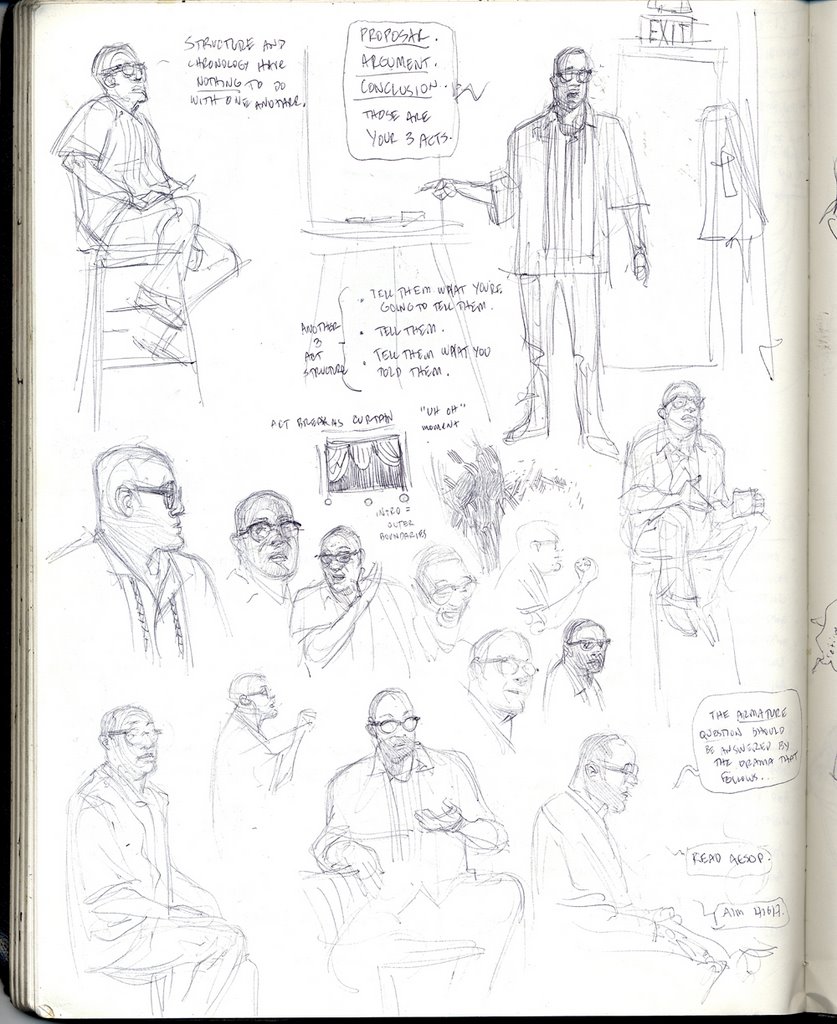
The sketches in this blog were done by my friend Derek Thompson who works for Pixar and has sat in on two different seminars of mine. This was his way of taking notes.


A few months ago I had the privilege of teaching my seminar at Pixar. Anyone who knows me knows that there are few modern storytellers I respect as much as I do those at Pixar. They are the best.

I was as nervous as I have ever been in my life. I worship these people. You think I’m kidding, but I cannot express here just how highly I regard their work. At one point while speaking I thought that I might pass out my head was spinning so fast.
All of this tension I was feeling was self-generated, by the way. The people at Pixar could not have been nicer. They were sweet, generous and humble people. Not one person swaggered with pride or puffed their chest out. These were the people who made Toy Story and Toy Story 2, A Bugs Life, Monsters Inc., The Incredibles and (my personal favorite) Finding Nemo and they walked with their feet planted firmly on the ground. And strangest thing of all -- they wanted to hear what I had to say about story construction.

My late friend Scott Tolson used to say after dispensing advice, “but what do I know, I’m just some guy.” That’s the way I felt – I’m just some guy. But they listened to me to see just what I had to teach them. As I said before these are humble people. This is a key element to their success.


I will repeat something from another blog here, but I think it’s appropriate. I was lucky enough to become friends with acclaimed playwright August Wilson a few years before he died. One day, shortly after we had met, I mentioned the story structure class that I teach, and he said that he should take it. I was blown away. I said, “You have two Pulitzers to my zero. Why would you want to take my class?” He told me a story about a guy he knew who had once met the great jazz saxophonist John Coltrane. The man sheepishly mentioned to Coltrane that that he too played the saxophone. Coltrane’s response was, “What can you teach me?”


August wanted to know what I could teach him. In fact, once I was on my cell phone and August approached and hovered around until I got off the phone. He then asked me for advice on his new play. I told him what I thought he should do and he took notes and listened. The man knew that he didn’t have all the answers and wasn’t afraid to seek them out. This was a man at the top of his field, but he showed the same dedication to continued learning that I would later witness at Pixar.


I have seen over and over again that the best people are humble before their craft and don’t lean on their past successes. They are hungry for knowledge and know that they will never reach that elusive goal of knowing everything. One must always move toward the horizon even though the horizon keeps its distance.

Friday, May 26, 2006

The Amazing Disappearing First Act


"Learn the fundamentals of the game and stick to them." --Jack Nicklaus

I hate to come back to the whole “three act” thing, but I find over and over again that people are not adhering to it. My belief is that the lack of strong first acts in films in recent years has much to do with the steady decline in movie attendance. No first act, no emotional involvement.

I think that I mentioned before that I have been studying magic. There are many benefits for storytellers who study magic, one of which is the importance of the first act. Even the simplest magic trick uses three-act structure. Christopher Milbourne in his book Magic Book put it this way:

“The magician can assume nothing. Unless an audience has been led to believe that a closed hand holds a coin, they will not be amazed when it is shown to be empty.”

He’s talking about having a clear first act.

This idea of being clear often frightens my students. They don’t want to point out the obvious. But what is obvious to them may not be so obvious to the audience. Milbourne’s book continues:

“If they are not aware that an object is green, they will not be astonished when the color changes to red. My friend [magician] Paul Ebling illustrated this point during a demonstration of gambling techniques. He passed around a pair of unprepared dice with white spots for examination. Then he announced he would shake the dice and roll a seven. The seven came up as promised. This was a far more remarkable feat than the spectators realized. Until Paul reminded them that the dice that the examined dice had been green, no one had noticed that the dice on the table were red.”

People only notice what you tell them to notice. If you want to involve them be obvious about what you want them to notice. Magicians understand this but over the years I have seen a decline in the understanding and importance of a strong act-one in storytelling. The tendency is to want to get to the meat of a story because that’s where all the fun happens.

I often use jokes as examples because they are little stories. Everyone knows the importance a strong first act when they are telling a joke. And the listener knows that everything that they are being told will help them understand the punchline of the joke. A listener would never say, “Just skip all of that crap and get to the ending”. And joke-tellers know so well that act one is important that when they are in the middle of a joke and have forgotten something they will be sure to go back and fill in the missing information: “Oh, wait, I forgot to say that the guy has a duck in his pants.”

But first acts are all but disappearing from films. There is almost no time spent setting up the characters and the world they inhabit before the inciting incident. They deprive the audience of any emotional involvement. Imagine a magician’s opening move being that he takes a card randomly out of a deck and asks triumphantly, “Is this your card?” Not much of a trick. With no set-up there is no trick. No emotional involvement. Same with stories.

Don’t be afraid to take the time it takes to give your audience all they need to know to become gripped by your story.

Monday, May 15, 2006

The Other Side of the Rollercoaster


It is at this time of the year that the studios put out their big movies – their “tent-pole” films. Their marketers will call these “non-stop rollercoaster rides!” Rollercoaster is the term that they use to describe films with relentless action. They promise all of the thrill, chills, twists and turns of tallest rollercoaster at Magic Mountain or Great America or wherever.

Why are these movies almost always a let down? Shouldn’t action scene after action scene be exciting?

Well, ask yourself what is the scariest part of the rollercoaster? The three-story drop? The corkscrew twist? The big loop? Probably not.

Anticipation is almost always the thing that scares us most. It is the calm before the storm that is the scariest. Imagine yourself in line to go on the world’s biggest and most frightening coaster – The Widowmaker (or something). Imagine the signs warning that those with weak hearts or back problems or pregnant women should not ride. Imagine seeing others on the ride before you. They scream in abject terror. All of this is all part of the experience – the anticipation. Imagine watching the cars maneuver through the loops, twists and spills of the coaster. You watch as people exit the ride, some exhilarated, others shaken and unstable. Some are just plain ill, to put it nicely.

Finally, it’s your turn. You are ushered into your seat where you are strapped in. The safety bar comes down across your midsection. Ironically, the safety equipment makes you feel even more nervous. How bad is this thing if they need all of this stuff to keep me safe, you ask yourself.

With a jolt your car starts to move. The butterflies in your gut are flapping like crazy. The first leg on the track is level. Then you see it – the track ahead stretches up and up and up. Your car starts to ascend. Click, click, click goes the chain that carries your car ever upward. It seems to takes forever to reach the top. You wonder again just how bad the drop will be when you crest this hill.

Then there is that sweet, terrifying, white-knuckle moment when at long last you reach the top. Here it comes.

The drop itself is more of a release of built-up tension. But these precious moments of anticipation are all part of what makes a rollercoaster scary. It is not wall-to-wall action alone that fills you with delicious anxiety, but the quiet moments as well. They are the yin and yang of the experience.

Movies that wish to duplicate this feeling often leave out half of the experience. They have almost no quiet moments.

Take a film like ALIENS. Now here is a film that most people remember as non-stop action, but there are many moments of quiet. Many moments that allow the audience to anticipate how bad things are going to get for the characters in the film.

So many filmmakers now want to cut right to the chase, the big explosion, the monster, the running and jumping, the firefight, the murder. There is no click, click, click as the tension builds.

They make the mistake of thinking that because the screams come when the monster shows up, that it is only the monster that is scary. They forget about the other part of the rollercoaster ride. It’s the same as thinking that the best part of a joke is the punchline, as if the set-up did not contribute to the joke. Why not a joke with no set-up, just one punchline after another? Wouldn’t that be the funniest thing ever? Wall-to-wall punchlines!

It sounds ridiculous, but it is the same thing as wall-to-wall action. It's the same ‘just the good parts’ philosophy.

No, just as the set-up is an important part of a joke so are the quiet moments of anticipation part of an action sequence. You cannot have one without the other.

So this summer when you emerge from the theater a little disappointed that you were not more thrilled by the action ask yourself if the filmmakers bothered to remember that a rollercoaster goes both up and down. Chances are they did not.

Wednesday, May 10, 2006

Inkblot Cinema


A while ago I had a talk with a musician friend of mine. He told me that he had gone to see a modern classical concert. He said that it was an awful cacophony, and asked, “What happened to the art of communication?” I thought that was a very good question, one I have often wondered about myself.

I saw a documentary on television about the phenomenon of genius; in it they said that it was a western concept that someone might be so smart that they could not be understood. Sometimes when an artist fails to communicate with her/her audience, the audience is blamed for not understanding. This is an easy out. It’s too convenient to put all the onus for communication on the listener. I have never been sure where the skill lies in confusing one’s audience. Any five-year-old can be unclear.

Unfortunately, storytellers who communicate clearly are often considered juvenile or pedestrian, such as Hitchcock and Spielberg. When Hitchcock was making films the intelligentsia treated him much the way Spielberg is treated now. His films were seen simply as “crowd-pleasers.” Yet both put so much attention on communicating with their audiences that their very names have become synonymous with film itself.

When I talk to people about communication in art, they often say that they don’t want to be handed everything – they want to figure things out for themselves. Artists who think this way often create confusing art. This is a common trait of intellectuals. The smarter people are, the more they like art that is obscure and difficult to understand.

Yet the smarter someone is the easier they are to fool. Magic, for instance, depends on the viewer’s ability to put together pieces of information and drawing the most logical conclusion. If a magician takes a coin and transfers it from one hand to another, and then the coin is made to disappear, chances are the coin never left the first hand.

But because by the time we are adults we have all seen objects pass from one hand to another countless times, we assume it has happened. I call this gap closing, and smart people are really good at it. A professional magician friend of mine confirmed my observation that scientists and skeptics are the easiest to fool.

Gap closing also happens when someone tells a joke. A joke is just a story with a part missing. That missing piece is supplied by the listener; when they make the connection they laugh. In fact, kids will often exclaim, “I get it!” They have pieced the clues together and closed the gap. With a well-constructed joke we all close the same gap – everyone draws the same conclusion.

If the gap is too close, as in the case of a pun, people often don’t think much of it. The further the gap, the funnier the joke. But there is a limit. Everyone knows if you have to explain it isn’t funny. It often means that the gap is too great and that most people can’t close it. Or that people are drawing different conclusions trying to close it.

I wish people held “art” the same high standards they hold jokes to – if you have to explain it, it isn’t working. Smart people will often fill in the gap with something that seems to make sense, but if you ask these gap closers what they “got” they will all say something different. I call this “inkblot art,” or when I’m talking about film, “inkblot cinema.”

With inkblot cinema people see what they want to see. They like what they see because they made it up themselves. But often they have done to themselves what the magician does; they have fooled themselves into seeing something that is not there. Like a skillful magician or comedian, a good storyteller can use this gap closing to his/her advantage. Hitchcock called it pure cinema. He let the audience close gaps all the time.

In Frenzy Hitchcock shows us a brutal murder. Later in the film, he shows the killer disappear into an apartment with young woman. As the killer closes the door, he uses the exact words he used just before he committed the earlier murder. Then he keeps the viewer outside the door to imagine what is happening on the other side. Everyone is closing the gap like crazy, but we are all closing the same one. We all know a brutal murder is taking place on the other side of the door.

Billy Wilder said, “Let the audience add up two plus two. They’ll love you forever.” Just make sure you have communicated well enough that the audience knows the answer is four. Don’t hide behind your inability to be clear or rely on the ability of your audience to make up something where there was nothing.

Bring back the art of communication.


(What I call gap closing Scott McCloud calls closure. Same observation. He has a great explanation of it in his book Understanding Comics. If you don’t have it – get it.)

Thursday, April 20, 2006

A Look Inside My Brain part 2


Flickering Images from Marcus Donner on Vimeo.


In this post I will once again explain my process while making a short documentary for the Seattle international Film Festival.
I feel that when doing a creative work it is best to place restrictions on one's self. These restrictions, or rules, give the piece an internal consistency. They also force you to be more creative. There is an old saying that goes, "Calm seas make a poor sailor". When you have something to challenge you, it's amazing what you can achieve.

In the heyday of Warner Bros. animation they developed rules about how to handle particular characters. For instance, they decided that Bugs Bunny would never just run around starting trouble, but that he should always be minding his own business when Elmer Fudd or some other antagonist would come along and start the trouble. Or in the case of the Roadrunner cartoons, the rule became that the Coyote would be hurt by his own incompetence and not through any malicious action of the title character.

Restrictions can be beneficial to any artist and if you have none, you should create them for yourself.

When I was selected to make a short for SIFF one of the first things I did (along with my DP and producing partner) was compile a list of rules and guidelines to follow. This list was written even before we knew our subject. Our subject would be pulled out of a hat a few weeks later. I called the list the Declaration of Principles. It is a reference to a list of ideals that Charles Foster Kane made in the film Citizen Kane. Here is our list:


Declaration of Principles

This document is to serve as a philosophical framework for the filmmakers of Brian McDonald’s Fly film documentary for The Seattle International Film Festival 2004.

1.) Always tell the truth. Meaning that nothing may be set up for the benefit of our camera or story. We want real people doing real things.

2.) The story is more important than the storytellers. In other words, we are not the story.

3.) The audience does not owe us their attention; we must earn it. We must have a point. Why should anyone care about our subject?

4.) People are more interesting than things. Just as in fictional storytelling conflict is more interesting than the lack of conflict.

5.) Style for style is sake will not be allowed. Our style shall be dictated by the needs of the story. This applies to all elements of the film: direction, photography, sound design, editing and music.

6.) The humanity of a story takes precedence over any technical concern. A bad recording of a great event is better than a great recording of a bad event. (This is courtesy of the director Mark Rydell)

7.) The old adage tell them what you are going to tell them, tell them, tell them what you told them shall act as our road map.

8.) Remember basic three-act structure.

9.) We can only tell one story. No matter how interesting another subject might be, if it has nothing to do with our story it must be cut.


Brian McDonald (Director) and Marcus Donner (DP/Associate Producer) compiled this list of principles on February 14th 2004.