"Invisible Ink is a powerful tool for anyone who wants to become a better screenwriter. With elegance and precision, Brian McDonald uses his deep understanding of story and character to pass on essential truths about dramatic writing. Ignore him at your peril."
—Jim Taylor (Academy Award?- winning screenwriter of Sideways and Election)
William Goldman, who wrote the script for Butch Cassidy and the Sundance Kid, is one of the most respected screenwriters in the history of the medium, and this film is one of the reasons. It has left an imprint on the “buddy picture” that has not diminished since its 1969 release.
What I love about this movie is that it has a laser focus—it knows what it’s about. Goldman knows his theme and drives it home at every opportunity. Sure, the film is fun.
But this film is much deeper than it appears. It says that we cannot run from death. Sooner or later the world changes, and try as we might, we cannot stop this encroachment any more than we can stop death from coming. It says that and it’s still funny. What more can you ask?
These two men are notorious bank robbers and in the very first scene we see Butch (Paul Newman) casing a bank. Upon seeing that it is heavily fortified, he asks a guard:
BUTCH: What happened to the old bank? It was beautiful.
GUARD: People kept robbing it.
BUTCH: Small price to pay for beauty.
Right off the bat the world is changing and challenging. These are the first lines spoken.
Not very much later—the very next scene in fact—we are introduced to Sundance. He is in a saloon in the midst of a two-man card game when Butch comes by to collect his partner. But there is a dispute and the other card player thinks Sundance has been cheating and says as much. The man, named Macon, also threatens Sundance:
MACON: You can die—no one’s immune—you can both die.
It is clear that guns are about to be drawn and Butch tries to talk his buddy out of shooting it out with the other man. He says to Sundance that he doesn’t know how fast Macon is. Then he says:
BUTCH: Well, I’m over the hill—it can happen to you—everyday you get older—that’s a law.
It is very precise language that gets to the heart of the film—the point of the film. Getting older is a law. It is a law that even these master outlaws cannot break. When most people say that something had good dialogue they do not mean this—this is great dialogue because it matters.
Goldman never drops the ball on this. At one point he introduces a brand new invention called a bicycle, which represents the coming future. In fact, Butch, who buys the bike at one point, discards the thing with the line:
BUTCH: The future’s all yours, you lousy bicycle.
But the outlaws keep trying to hold onto to their past—to the old world. At one point they rob a train. They have robbed this train before and the owner of the company isn’t happy about it. He hires a “Superposse,” as the screenplay calls them, to hunt down Butch and Sundance.
This posse is almost superhuman in their ability to track Butch and Sundance over every type of terrain. They never seem to tire. They are relentless. And we never see their faces. They are almost always black silhouettes in the distance. They are death. And you cannot outrun death.
I won’t tell you the ending, but it is the only ending there could be to this story. This story may not sound like it would be fun to watch, but it is. It’s great. I wish any film I could see in the theater today had as much to say and could say it with the skill of Butch Cassidy and the Sundance Kid.
Most classic films are classics because they are done with much more skill than the others. Much more focus and precision. That’s a law.
Last season I was a writer for the show Hoarders. That’s the A&E reality show about people who are compulsive hoarders and the problems it causes them and their loved ones.
How does one “ write” a reality show, one might ask.
Well, what we did is look through all of the footage and transcripts of the 40 hours of tape, find the story there, and reduce it to 22 minutes. Hard work. But we were using the wrong verb. We weren’t writing—we were structuring. We were storytelling.
I think our cultural emphasis on the written word has confused us as storytellers. We have been calling the task “writing” when we are “ storytelling.”
Some of the worst advice writers have ever gotten, I think, is that writers write. No, writers tell stories.
I recently spoke with a writer who has been writing a novel for years without much progress. I also spoke with a short story writer who is having the same problem. They have no idea what to write and believe that the act of writing something down will magically produce a story. It doesn’t, and it won’t. But we have been trained to believe that it will.
If we are lucky sometimes writing sparks an idea for a story, but more often then not it doesn’t.
And if it does, the story meanders because it was created in a roundabout way.
How many of you have stories you started, but abandoned because you had no idea what comes next? You got lost in the woods because you had no path to follow.
We have been taught that as long as we are producing words we are doing something. But while we may be getting better at putting words together, we are not making any progress as storytellers. We are running as fast as we can inside a hamster’s wheel.
What if we started to think of ourselves as storytellers first, instead of as writers? After all, storytelling doesn’t necessarily require words. The silent movie era is a testament to that. So is any Norman Rockwell painting.
In fact stories without words can have enormous power. Just look at the first acts of
Pixar’s UP or WALL-E.
So what if when we sat down we gave ourselves a task other than producing words: Changing the verb from writing to storytelling may change the way we think about the work.
This would require thinking more than we wrote. We have years of training telling us that thinking is not working. But it’s the hardest work of all. Producing words is relatively easy if they don’t have to add up to anything. Or if one believes that somehow a story will be born out of the act of typing.
It is much harder to know what we want to write about before we start typing. But if we do this work, the string of words we do put down matter more. Every word is a brick on a path leading us to our destination.
If you are not used to working this way, it will at first give you a headache and you will want to abandon this method. It’s too hard, you will think. But push through that feeling. Try to redefine yourself as a storyteller rather than a writer.
I think you’ll find that becoming a good storyteller will make you a far better writer.
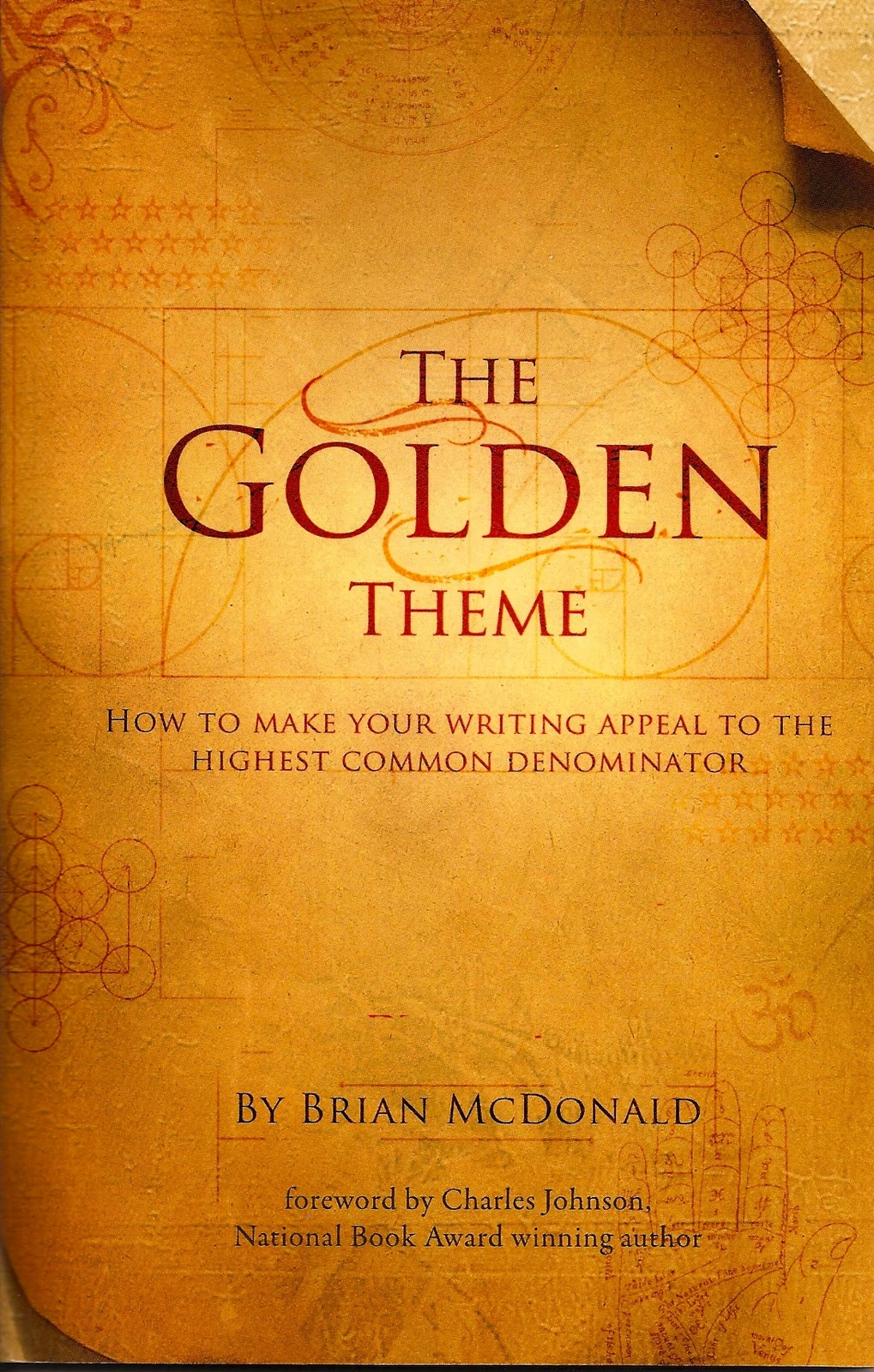
I know some of you out there have been waiting for my new bookThe Golden Theme,well it’s sort of here. What I mean is that it is available for pre-order on Amazon. It will be a week or two before you can hold it your hot little hands, but you can order it right now.
Sorry, Amazon takes a while to put up a cover image for some reason.
Anyway, this is from the foreword by National Book Award winner Charles Johnson:
“Brian McDonald is one of the world’s wisest teachers of
the elements that create great storytelling. On this subject,
you can trust everything he says, because there is simply no
angle or aspect of storytelling – what stories mean and our
experience of them – that he has not deeply reflected upon
(and from the standpoint of numerous disciplines in the
sciences and humanities), then drawn a conclusion that we
can take to the bank….
…If I had not retired last year from teaching classes on literature and
the craft of writing at the University of Washington, I would place
McDonald’s two books before my undergraduate and graduate students as
you are a non-writing reader who just loves stories, read it. If
you are a teacher, share it with your students. And give it to
friends, who will thank you for the clarity Brian McDonald
so generously brings to our lives.”
-- Charles Johnson
I want to thank everyone for getting the first book, Invisible Ink, and saying such nice things about it. I’m proud of The Golden Theme and hope that you all like it.
“Being ignorant is not so much a shame, as being unwilling to learn.” -- Benjamin Franklin
Before I start this blog post I will warn you that there is a little bit of swearing and a bit of imagery that may be slightly off-putting to some. But I think the lesson of this post is an important one and worth the risk of offending.
I am often taken aback by students and others I talk to who say they want to learn about something, but then reject information about their subject of interest.
An aspiring screenwriter once approached me. She told me that she was looking for the secret to engaging an audience. She said that there must be a way to hold an audience spellbound and keep their attention. She spoke with the passion of a person on a quest for the secret to the universe. She went on for a while wondering aloud if there was some trick or technique that might help her engage an audience in this way.
I told her that she should read interviews with Alfred Hitchcock, because he was quite articulate about how to involve an audience in your story.
The woman scoffed and said, “I don’t like Hitchcock’s movies, so I don’t care what he said.”
My head still spins when I think about it. Hitchcock had a fifty-year career all because he knew how to play an audience like a fiddle. His nickname is Master of Suspense. The man has a list of classics as long as my arm and this would-be screenwriter blew him off like a one-hit-wonder.
The truth is she didn’t want the answer to her question—she wanted to be on her intellectual quest. For her, pondering this “unanswerable” question was its own reward.
One of the other things is that people will say to me that they’d like to take my class, just to learn screenwriting. They will say, these people, that they already know how to write because they write poetry or something.
They have already made they assumption that they have they aren’t learning a new craft, but merely learning a few technical details particular to screenwriting. This is like a biologist deciding that he can build a rocket ship because he is a scientist after all. How different can it be?
I see this all the time: People dismissing new information with confidence—even cockiness—born of ignorance.
I was once introduced to the friend of a good friend of mine. Both of these people are trained martial artists. This woman, during our chance meeting on the street, mentioned that she was creating her very own martial art. This sounded ridiculous to me, and I wondered just who she thought she was.
When she and my friend were finished with their visits we said our Nice-to-meet-yous and she walked off.
As soon as she was gone, my friend turned to me and said that this woman was the best martial artist he had ever seen—she knew many martial arts and was a champion in them. Whenever she wanted to learn a new form, she never told her teacher who she was; she would take the class as if she was a beginner. She learned the basics and worked her way up to the top.
This is a person who can put her ego aside in order to learn something new. Impressive.
More than once I have finished teaching a class and students have excitedly told me how much they learned. And they say that they want to learn more. If I give them a list of movies to watch, they often point out the films that they have already seen and tell me that they don’t need to see those. Or they will watch some of the films and report back on which ones they didn’t like.
Understand that after the class they tell me how much I changed they way they “see” stories, and yet they blow off the very thing I know will help them learn more: patient study.
First, they shouldn’t refuse to watch a film they have seen because now they are looking with new eyes. They know more than they knew when they saw it before. And secondly, if they don’t like a film on my list, what they should do is ask themselves why I thought they could learn from it.
I had one student who watched, and didn’t like, Billy Wilder’s The Apartment. He had no idea why I thought it was good. But you know what he did? He watched it again. And again. And again. Until he saw what I saw. Now he loves the film and sees the craftsmanship that was invisible to him before. He did the very same thing with Hitchcock’s Rear Window. He now loves that film as well. And he has learned too how to be a better storyteller.
The following story is a little vulgar, but worth telling to make my point, I think.
I used to know a man from a West African village. We once talked about his manhood initiation ritual. He said to me in his thick accent, “In my village when you are a boy in manhood training you must go take a shit (he pronounced it sheet) in the woods.” He paused. “Then you sit all day and you watch your sheet.” Then he paused for a long while. I had no idea what he was getting at. Then he said, “Then you see everything that depends on your sheet.” The boys learn, from this exercise, their vital connection to the rest of the living world. This is a profound lesson to emerge from such seemingly pointless act.
Remember that sometimes when someone is trying to teach you something new, your job is not to judge what he or she asks you to do, but to fully understand why you should do it.
If you do this, you may be surprised by what you have allowed yourself to learn.
"Everybody is ignorant, only on different subjects." ~Will Rogers
In my life I have known many artists who dismiss the idea of structure when it comes to art – and with stories in particular. It doesn’t feel organic for them to work with a plan or to impose a form on their art. They believe that their art will lose emotional power. This is a mistake.
I was once invited to see the one-woman show of an actress I know. She’s a really good actress, smart, funny, quick, talented, and skilled. She gave me tickets to her show and said that following the show there would be a Q&A. I went to the show along with two guests.
Before the show began the theater was packed and abuzz with anticipation. This actress has quite a local following and people expected to be thoroughly entertained.
They were not disappointed. The show was funny and engaging and after a spectacular crescendo the lights came up to thunderous applause.
People took this time to grab fresh air and others to smoke in front of the theater.
My friends and I talked about how much we liked the show and debated whether to stay for the Q&A. I thought that I should because she did give me free tickets. So we stayed. But many people did not. I would say more than half of the audience left.
We sat back down expecting the Q&A, but the lights dimmed and, much to our surprise, there was a second part to the show.
When that ended the Q&A did follow. During the Q & A my friend, the actress, commented on the audience that had left at the intermission. She said something to the effect of, “Some people get what I do and some people just don’t get it.”
This is not an unusual reaction for artist who work strictly from the gut. The “They don’t get me” defense. There are times when that can be true, but mostly it’s the artist who doesn’t “get it,” not the audience.
Thousands of years of conditioning have taught us the natural shape of a story and if you don’t understand that this is so, you may not be clear on just what you are communicating to your audience.
People will often tell me that a film is well structured, but that it is too long. I don’t believe that there is any such thing as too long. Some of the longest films I have ever seen are short films.
But when a story is aimless and meanders people have no idea of its shape and become uneasy. How many times have you felt like a film was going to end only to have it continue for another 20, 30, or 60 minutes? Each minute past the time when you thought the film was over is a minute too long. It’s poor structure.
If you understand structure you can use people’s expectations to your advantage. I’m not talking about breaking rules so much as bending them.
If you look at James Cameron’s film Aliens, he makes use of audience expectations to create a false ending. There is a fiery climax followed by what appears to be a wrap-up. But we soon find out that this story is not quite done.
Why did this work when my friend’s false climax did not? It’s because the story did not truly resolve. The heroine, Ripley, must do battle with the monster of the story. She must conquer her fear by confronting it in the form of this alien.
At the beginning of the story Ripley is haunted by nightmares of aliens and after this final battle she is free of these dreams. The end.
What my friend failed to realize is that she communicated to us that her show was over. Her show came to a conclusion of an idea culminating with a climax. She told us it was over. But because she did not understand what she had done, she could only blame the viewers.
Understanding the basics of story structure would have helped her keep her audience, and it will help you keep yours.
This is not my regular kind of post. Today would have been the birthday of my good friend Scott, whom I met 30 years ago. And since this is also the 30th Anniversary year for The Empire Strikes Back I thought I would post this short documentary I made in his honor one more time. If you are tired of seeing it I apologize.
"I happen to think that the singular evil of our time is prejudice. It is from this evil that all other evils grow and multiply." -- Rod Serling
This is important to me. Up until now I have tried to keep the focus of this blog on film and filmmaking with an emphasis on story construction. And this post will not stray too far from that, but you will get a view of my politics that I have mostly left out of this blog. I may alienate some people, but I am willing to take that chance.
I believe deep in my heart that stories exist to teach us. I go into this in great detail in my second book The Golden Theme, which will be out before the month is out, if all goes smoothly.
I believe that our stories contain the collective wisdom of everyone who has ever lived.
Why do I bring this up? Because I think there is a story that we need to pay attention to right now. Like all good stories, it is timeless and so appears to be timely.
You don’t have to read many of my posts to know what a hero Rod Serling is to me. In 1955 there was a very famous lynching of a black teenager named Emmett Till. This lynching shocked the nation and Rod Serling wanted to write a television play about it.
The sponsors were so worried about the Southern response to the story that they edited Serling's script beyond recognition.
Serling wanted to tell stories that mattered. He decided to make his points in an indirect fashion and created his classic television show The Twilight Zone.
Now, if you are a regular reader of this blog you know all of this. I bring it up because of something that happened this weekend at an anti-Muslim rally in New York. This was a rally about the Islamic community center planned two blocks from Ground Zero, which has been erroneously dubbed “The Ground Zero Mosque.”
At this rally a man was harassed and accused of being a Muslim by an angry, hateful crowd.
I suggest that you please watch it and see if you can tell how little we have changed since Mr. Serling wrote this mini-masterpiece fifty years ago. See if you notice how little we have learned to see the humanity in our neighbor – and how quickly we turn to anger, hatred and suspicion.
It’s high time we grew up.
“We have met the enemy and he is us.” – Walt Kelly in his Pogo comic strip
My step father once told me, when I was a kid, that what made someone a professional rather than an amateur was that they were paid for what they did.He was wrong.
Many people use my step father’s explanation for what makes a professional and I find that it leads to shoddy workmanship because it takes the focus off of getting good at what we do and shifts it to getting good enough to get paid.Or even worse just getting paid.The craft is often thrown out the window in favor of just doing whatever it takes to get paid.
So I meet people all the time that are very interested in becoming screenwriter or filmmakers and the like, but they have almost no interest in the craft itself.They want money, or fame or some other outward indication of success.But the idea that they should be able to do good work and do it consistently is beyond them.
This is not to say that they don’t want to do good work.The problem is that they assume their work is good simply by virtue of having been made by them.The work needs to meet no other standard.
When I talk to these people about standards of quality or craft that takes years to master they shrug it off.That takes too long.Learning.Mastering.They just want the money and I make it sound like too much work.
My friend Pat Hazell talks about talking to writers starting out who are obsessed with getting an agent.His response is always, “what do you have for them to sell?”It’s amazing how often they have nothing.
August Wilson once told me that people used to ask him how they could get a play on Broadway.He would then ask them if they had a play and they would often say no.He would then tell them to write a play and then write another play.He told them to keep writing plays.He told me that they would get mad at him like he had a secret he wasn’t telling them.The truth is the secret is always hard work.
And if they have something that they know needs work.He always tells them that their scripts must be bullet proof.
If you thought that your script (or whatever product) could be better than why do you think you should be able to sell it?
You have to learn to feel rewarded by the quality of your own work -- and not to be delusional about the quality of your work.
One trick is to study the classics and to compare your work to those.Most people see a bad film and, “Say I could write that.”But if you are only trying to be as good as the worst thing you have ever seen you aren’t doing yourself any favors.
Compare your work to the best work you can find.Write as close as you can to that level.
Another great trick is to get your script, get it as good as you can, print it out, bind it and hand to someone you trust to read.A strange thing will happen – as soon as you hand it to someone to read you become aware of everything that is wrong with the script.
Those things that were nagging you that you thought you could get away with will become very clear to you.Fix those things.Even before you get notes, fix those things.
Work, work, work on this stuff until it’s as good as you can get it.
If you want to sell a screenplay for one million dollars put in a million dollars worth of work.
To put it simply, one is not a professional when they get paid – one becomes a professional and then gets paid.
"OVERALL THEME LEADS TO CHARACTERS THEN ON TO PLOT"
-- Rod Serling
First let me say that I debated with myself about writing this post because I’m not particularly interested in singling out Mr. Shyamalan in such a public forum. Let me just say that there is a kind of bravery that all artists have to have because they put their work out there to be judged by just about anyone.
I have learned that few people have that kind of bravery.
So I only use Shyamalan as an exemplar of the kinds of mistakes I see made—often—by other writers and filmmakers these days.
I love movies. I know we all do, but because I haven’t liked many films since marketing took over the business in the ’80s, I get accused of being negative about film for the sake of being negative. There have been some great films in the last couple of decades but, in my opinion, the frequency of the truly great is far less than it was before. I would like nothing better than to have the feeling I had when I went to the movies as a kid in the 1970s and early ’80s. But that almost never happens anymore.
Many of my students know that I was one of the few dissenting voices when The Sixth Sense came out. I didn’t think it was that good. And please, I have heard all of the arguments for the film’s appeal. If you enjoy the film, I wish I was there with you, but I am not. This is not to say that I wasn’t sometimes entertained by the film, but I didn’t think it was very well written. In fact, there were times when I thought it was even amateurish.
I said, after I saw The Sixth Sense, that Shyamalan would probably never make a film people liked as much. That’s because all the flaws people are seeing in his work now are the flaws I saw in his early work. I was simply a canary in a coal mine.
How did I know? How did I have a sixth sense about Shyamalan’s future? Craft. I could see a lack of story craft. People who are not practitioners of something are often impressed with the obvious. People who don’t act, for instance, think that crying on demand is good acting. Or that being able to do accents or memorize lines is good acting. Trained actors know different. A lot of work that people don’t notice as easily goes into great acting.
In writing, the twist ending is one of the things that people are very impressed with. Since my first big writing influence was Rod Serling, all of my very early writing were stories with twist endings. It was one of the first things I learned to do writing-wise. So I ain’t impressed.
Rod Serling is often cited for his twist endings on his classic television show The Twilight Zone and so Shyamalan is often compared to him. Never mind that Serling had several Emmys for straight drama before he ever wrote the Twilight Zone.
But the thing that bothers me the most about this comparison is that Serling stories were driven by strong themes. Shyamalan’s are not.
Serling’s endings were linked to the story’s theme—not some theme that the viewer makes up in his head because the story was so vague and unfocused, but a real theme that was the reason to tell the story in the first place.
Let’s look at the original Planet of the Apes co-written by Rod Serling. It is very much like a feature-length Twilight Zone. (By the way, I used to tell people that Planet of the Apes was just a long Twilight Zone, that it had all the same structure, but people said that I was crazy. Then some guy cut a short version of the film and made it into a Twilight Zone and people were surprised how well it worked.)
Okay, back to the monkey movie. Planet of the Apes was a film where the twist blew people away. I was a very young kid when the film came out, but I remember my father and other people talking about it. The ending became quite famous.
In the opening of film an astronaut on a starship tapes a log. In it he talks about how long he’s been away from Earth and that much time would have passed on Earth because he and his fellow astronaut have been traveling a light speed. Then he says:
“I wonder if Man, that marvel of the universe, that glorious paradox who has sent me to the unknown...still makes war against his brother, and lets his neighbor's children starve.”
This is the theme that the entire films explores—are human beings essentially war-like, self-destructive creatures? The story never loses track of this.
So, Taylor, the astronaut, and his fellow travelers crash land on an unknown planet. At one point, as they walk through a desert looking for food and such, they have this exchange:
LANDON (heatedly): You thought life on Earth was meaningless. You despised people. So what did you do? You ran away.
TAYLOR: No, not quite, Landon. I'm a bit of a seeker myself. But my dreams are a lot emptier than yours. (pause) I can't get rid of the idea that somewhere in the Universe there must be a creature superior to man.
There it is again. Human beings are not so great.
Later Taylor is captured by intelligent apes with the power of speech. On this planet, human beings are primitive brutes that cannot speak (Taylor was injured during his capture and cannot talk). One of the apes, Dr. Zaius, talks to another in front of Taylor’s cage:
Zaius: Men are a nuisance. They outgrow their own food supply in the forest and migrate to our green belts and ravage our crops. The sooner they're exterminated, the better.
Here it is again. Humans are self-destructive. But this time out of the mouth of someone other than Taylor. Now Taylor finds himself trying to argue on the side of humanity.
This point of view is consistently stated throughout the film.
At the end of the film, Taylor escapes the apes and this strange planet only to discover the Statue of Liberty buried in the sand. He has been on Earth the entire time. Humans have destroyed the Earth. This “twist” is right in line with what the film has been saying the whole time. We brought about our own destruction by way of a nuclear war.
If the three acts can be defined: Proposal, Argument, and Conclusion, then we can look at the tape log at the beginning of the film as a proposal. And the second act as the argument when the opening statement or proposal debated. So the conclusion of the film is proof positive of what the film has been saying all along.
This is not just a trick—it is storycraft.
But Shyamalan’s twist is a trick. It was clear to me from the start. Don’t take my word for it; listen to the way he talks about his film. He was only concerned about the trick of the film. The ending of the film was surprising and explained why things happened they way they happened in the story. But there was no thematic reason for that ending. None.
You may argue with this, but if he knew what he was doing why can’t he repeat it? Rod Serling was able to.
What I saw with The Sixth Sense has become visible to most people by now. When I saw the trailer for The Happening people were intrigued until M. Night Shyamalan’s name came up and then they groaned. I have been told by several people who have seen the trailer for Devil, a film he produced, that when Shyamalan’s name comes on the screen the audience laughs.
I have to say that within the first few moments of The Sixth Sense, I had to stifle a laugh because I thought the exposition was so clumsy. Now at least I am not laughing alone.
I have many films that I love, but there are only a few I wish I had made. One of those films is Paper Moon. And then there are a few films where the pure craftsmanship brings me to the verge of tears. These films make me shake my head in admiration and disbelief at their excellence. Norma Rae is one of those.
I told someone that it was one of my favorite films, and she was surprised because the film has a female protagonist. That doesn’t matter to me at all; if the character is a human being truthfully portrayed that’s all I need. Race, gender, religion or any other circumstance of the character makes little difference. Is the story truthfully told? That’s what matters.
The film was released in 1979, and Sally Field plays Norma Rae, a woman from a small southern town who struggles to organize a labor union in the textile factory where she works.
It doesn’t sound exciting, I know, but it is real human drama that is engaging and entertaining. It is not boring because it deals with “important” issues. In fact, one of the most beautiful things about the film is that Norma’s personal story is the story. The story is really about how she grows as a person. She learns that she has a value beyond her sexual relationships with men.
The storytellers understood that in order to make viewers care about the issues they would have to use drama to do it. What I mean when I say “drama” is that they knew to tell a human story full of emotion.
As I pointed out to someone recently, the Greeks, who invented the dramatic form we use, knew that it was based in emotion—not puzzles or philosophy. That’s why the symbol they (and we) use for drama are the masks of Comedy and Tragedy—not of someone thinking. The Greek are pretty well known for their philosophers, but it’s clear that they felt drama served another function.
Norma Rae uses emotion to make its point. It tells the story of a person standing up against a corrupt system and suffering the consequences. It challenges us to stand up against our personal Goliath even though we are small.
One of the very first things you see Norma Rae do in the film is an example of the beautiful craftsmanship. (Remember, the film is about her trying to get a union for her fellow workers.) Well, the film starts with Norma Rae helping someone.
I will often say that a film is focused, and this is what I mean. Nothing is random. This film knows what it’s about from the very beginning and stays on track.
Most of the filmcraft will be invisible to you, but I assure you it is a meticulously made film. They just hid most of the work so well that you can’t see it. But you can’t make a film like Norma Rae by accident.
I wish I had written this movie, but if I had written it in our current film climate it would more than likely be sent back by my agents because nothing blows up and there is no twist ending. And they would be right not to send it out because the studios don’t make films like this anymore. It’s a cryin’ shame.
Rent Norma Rae—you won’t regret it. But I have to warn you there’s no CGI.
"People make a mistake who think that my art has come easily to me. Nobody has devoted so much time and thought to composition as I. There is not a famous master whose music I have not studied over and over." -- Mozart
Sometimes I forget just how lucky I have been on my journey of learning my craft. I have met some of the smartest and most generous people one would ever want to meet.
They were all very happy to teach me all they knew, but the most valuable thing they taught me was how to see and where to look. And if you know how to see and where to look, everything else will take care of itself.
Back when I was a teenager (this was around 1979 or ’80) I got my first after school job at a small animation company called Trickfilm, owned by a man named Bruce Walters.
God knows why Bruce took me in, but he did. He did motion graphics, but at the time we didn’t even have the term. This was before computer graphics, even. We just said that we did titles for commercials. Anyway, Bruce was (and still is) a very observant guy. If we were simulating neon, we would look at neon. Really look at it--try to see what made neon look like neon. Or if we had to simulate gleam on metal, we would look at the way light played on metal.
This may seem like basic stuff, but I meet people every day who do not do these things. If they have to paint clouds they won’t bother to walk outside and look up. Maybe they will look at how other people have painted clouds or find pictures of clouds on the Internet. They just assume they’ve seen enough clouds in their life and can wing it.
But it is amazing what you see when you take the time to look. You will things you would never expect to see.
Sometimes, though, it is very helpful to see how others have tackled the same problem before you. I once had to create shadows in an animated TV spot, and I had read about how Disney had done it in the 1930s for Snow White. I used the technique and it worked like a charm.
That was another thing Bruce knew--history. He knew the history of his craft. He knew how effects had been done from the very beginning of film. Knowing the past helped him innovate.
Bruce went on to head the animation department at ILM in the mid-1980s. I remember like it was yesterday when he was hired there. He didn’t even know how to use a computer. He said, “They say it’s not too hard because they have this thing called a ‘mouse.’” I’m serious, that really happened.
But this guy, who was not up on the latest technology, knew his history and was later able to invent the digital matte painting.
But when I talk to young filmmakers and screenwriters, they’re doing well to know the name of one or two people who did the job a generation back. If they went to film school they know a few more.
I tell people all the time that they should read old interviews with those storytellers who came before. I really do think they were smarter than most of us who do the job now.
I swear to you they have much to teach you, but that knowledge sits quietly in books mostly unread. Some of what they have to say in mind-blowing and might have a lasting impact on your work.
If you are a screenwriter, filmmaker, or any kind of storyteller, I suggest you read Television Plays by Paddy Chayefsky. Read his essays about how each play was constructed. It is the cheapest film school you could ever attend. The man was a genius.
You may start with Chayefsky, but don’t stop there. Keeping studying those who came before. As with Bruce Walters, it may be knowing how things were done in the past that will help you create the future.
“I'm trying to take culture and put it onstage, demonstrate it is capable of sustaining you. There is no idea that can't be contained by life: Asian life, European life, certainly black life. My plays are about love, honor, duty, betrayal—things humans have written about since the beginning of time.”—August Wilson
August Wilson was fond of saying that he didn’t do research. When I asked him about it, he said, “I figure if they had horse-drawn milk wagons when I was coming up in the ’50s then they had them in the ’20s.”
The truth is August researched all the time. He read a lot for one. But he also spent a ton of time with people, all kinds of people. People fascinated him. And he wasn’t quick to judge them—he was far more interested in what made them tick. He wanted to know why people did what they did. Or how people got to be who they were.
If you are a storyteller then your job is to observe and report on human behavior—the world is your classroom. You have to be a keen observer of human behavior. And the great thing about humans is that they are everywhere. It is safe assume that you see and interact with a human being almost everyday.
No matter what you are telling stories about at its core will be human emotions and motivations. You can get many details wrong, but if your characters don’t behave as people do in real life all the other research in the world will not help you. You have to learn how to “see” people.
I would say that “seeing” is at least as important as “doing” when it come to art. Art is about both how you see and what you see. When someone does something you would never do or can’t understand ask yourself why. You have to do this with clarity and without judgment. This is the hardest part of observation—to do it without judgment.
Why is it important not to judge your characters? Because characters who are judged by the storyteller tend to be caricatures rather than characters—cut-outs rather than real people. Over the years I have met many writers who are quick to judgment, but few who strive for understanding. And good story writing is honest. Sometimes painfully so.
The best place to look is inside yourself. But not at the parts of you that you think are great. No, you must find those things about yourself that you’d rather not look at. The things you keep in the dark. That’s where you mine the real dramatic gold. That’s where the humanity is.
Look at others, look at yourself—find the humanity in both. That’s how you write something that matters.
"If your work shows, you're in trouble." --Chuck Jones
I was once writing a script on a particular topic, and as part of my research I was reading the "For Dummies"book on this subject. Someone saw me reading this book and scoffed. I took that to mean that I should have been reading a more "serious" book on the subject. Why? To avoid embarrassment? I wasn't trying to impress anyone--I was trying to learn enough about my subject to write about it.
Don't fall into the trap of trying to impress others with your research. This can rear its ugly head in the writing itself. You want to show off all of the work you did. But this only takes focus away from your story and characters and puts the focus on the writer. This kind of storytelling pulls people out of the story rather than sucking them in.
The more people are emotionally invested in your story the more effective it will be. Don't show your work.
Another trap of research is procrastination. Writers love to procrastinate. If procrastination were an Olympic event writers would win the gold every time. Research is perfect for writers because we can fool ourselves into thinking that we are working. We can research a subject for years and make ourselves believe that we are working. Now, some subjects really do take years to research. They really do. So how do you know when you are done?
The trick I use is that when I start to feel like I have read most of the things more than once. In other words, when information is repeated by several sources, I quit my research.
Another thing that can happen is that research sparks other ideas. You may start off with one idea and upon researching the subject you discover other things you could tell stories about. Now you can't decide what to do. This is just another form of procrastination.
What you do is make a decision. You can always tell those other stories. Just pick one and tell it. There will more than likely be one that pulls you more than the others. You may be afraid of this idea because it may be more challenging, but that's exactly why you should choose it.
Okay, time for me to get back to work. When I want to procrastinate I write a blog post.
Before I start I want to thank all of you who have promoted my new book on your blogs. And also thank you all very much who have bought the book. I am grateful that you think I may have something worthwhile to say to you.
A playwright once told me that I should write a book about how to research for writing stories. Until she said this I had no idea that I was any good at it. But I have noticed that people will often comment on a feeling of authenticity in my work and if that is true at all it is due to research.
I divide research into two areas – “soft research” and “hard research.” Hard research is what most of us do. This is research for factual data – things like when was the Spanish American War and why was it fought. Or finding out how tall George Washington was. Or who is buried in Grant’s Tomb.
These are just hard facts easily looked up in a book or on the Internet. But there is another kind of research that I find even more valuable – this is soft research.
Back when I was a teenager trying to learn my trade I read an interview with Lawrence Kasdan just after Raiders of the Lost Ark came out. I was obsessed with Raiders and Kasdan. And because he had written the screenplays for both Raiders and The Empire Strikes back I wanted to read anything he had to say. I would follow his advice to the letter.
Well, in this interview he said that one of the things he did when doing research for Raiders was read books and see movies that came out the year that Raiders took place. That made sense to me. This is why there is an authentic voice to the piece. It feels very much like something from the 1930s.
Kasdan’s approach is a perfect example of soft research. This kind of information goes beyond facts. It gets to the feeling of things – the intangible. And these things can make their way into your story or art or whatever in ways you could never predict.
When you are engaged in soft research you should do so without a goal. You should just be open to taking in information. Take everything in.
When the guys at Pixar were making Finding Nemo they got certified to scuba dive. This gave them the experience they needed to make their film feel like it was taking place in an actual environment.
I was once working with animation students on a project that took place in the woods. I could not convince them to go spend time in the woods to soak up the environment. They thought looking at pictures of trees on the Internet was the same thing as going into woods and looking at real trees. It isn’t.
There are things those students could have learned in the woods that they never could learn. Bruce Lee said, “If you want to learn to swim, jump into the water. On dry land no frame of mind is ever going to help you.”
As much as possible you want to “get in the water.” Soft research puts you in the water. When you are immersed in the world, you want to recreate you will have a much easier time doing so.
If I am writing a piece that takes place in the past I will see films, read books, listen to music, watch television shows, listen to radio shows, watch talk shows and look at art made at the time. I find that comic strips are good because what people laugh at tells you a lot about what they were feeling at the time. They really tell you about what people were serious about.
Hard research is the key to making your work accurate, but soft research is the key to making you work feel accurate.
Thanks, everyone, for visiting this blog. I’m still getting used to the idea that people care what I have to say. Some people hate what I say while others find it useful, but it’s just a strange feeling to have people care one way or the other. Sometimes the only way that I can muster up the courage to write this blog is to pretend to myself that no one reads it.
I didn’t even want to start this blog. Truth is a friend of mine thought I should have one and created this blog and told me to fill it in. I figured I might as well. That’s pretty much the way I started teaching too. I needed the money and someone thought I’d be good at it. Turns out I am pretty good at it. Who knew?
A few years ago some of my students and a few friends told me that I should write a book. I had never written a book and didn’t think I could do it. Anyway, in 2003 I wrote one. People liked it, but no one wanted to publish it until now. You can read about that here: http://thesunbreak.com/2010/03/01/brian-mcdonalds-invisible-ink-guide-to-story-hits-print
The book is titled Invisible Ink, just like this blog. In fact, the name of the blog comes from the book. If you have liked this blog, the book takes the same ideas and expresses them in more detail. Thanks to all of you for reading the blog all these years, and I hope you will find the book helpful.
Here are some of the people who did me a huge favor and read the book in manuscript form before there was any publisher in sight. I am eternally grateful to them. They all did this because they believed in me and my book. They did this out of the goodness of their hearts to help me get this thing published:
“Writing stories is hard. They are stubborn by nature. No matter how many times you master one, the next story is obligated to conceal its faults with an entirely new disguise. Your only recourse is to keep writing, while concurrently increasing your understanding of this deceivingly simple, yet highly complex, organism we call story. Brian McDonald’s insightful book does just that. Somehow, Brian has found yet another fresh and objective way to analyze how great stories function, and emboldens you to face the challenge of scaling whatever story mountain looms before you. If I manage to reach the summit of my next story it will be in no small part due to having read Invisible Ink.” —Andrew Stanton (cowriter Toy Story, Toy Story 2, A Bug’s Life, Monsters, Inc., and cowriter/director Finding Nemo and WALL-E)
“Invisible Ink is a powerful tool for anyone who wants to become a better screenwriter. With elegance and precision, Brian McDonald uses his deep understanding of story and character to pass on essential truths about dramatic writing. Ignore him at your peril.” —Jim Taylor (Academy Award™- winning screenwriter of Sideways and Election)
“Brian McDonald’s Invisible Ink is a wise, fresh, and highly entertaining book on the art of storytelling. I read it hungrily in one sitting, delighted by his careful and illuminating analysis of my favorite films, novels, television shows, and even comics. A multitalented creator, McDonald never errs in his critical judgments or the very practical principles he provides for creating well-made stories. I recommend this fine handbook on craft to any writer, apprentice or professional, working in any genre or form.” —Dr. Charles Johnson (National Book Award-winning author of Middle Passage)
“If you want to write scripts, listen to Brian. The guy knows what he’s talking about. A very well-thought-out, easy-to-follow guide to the thing all we writers love to pretend we don’t slavishly follow—story structure.” —Paul Feig (creator of NBC’s Freaks and Geeks)
Invisible Ink is an uncommonly good guidebook that reveals the unseen workings within great movies, TV, and literature. Brian McDonald, the author of the guidebook, is like a modern day magician who understands the enchantment that lives within a good story, and fortunately for us, he is ready to share his many secrets. —Joel Hodgson (creator of Mystery Science Theater 3000 and Cinematic Titanic)
“Don’t tell anyone, but the secret to exceptional story crafting is written in Invisible Ink. I advise you read it, memorize it, and then eat the pages one at a time and digest it thoroughly, so that it stays with you. Besides, you can’t afford for this book to fall into the hands of your competitors. Brian’s powerful concept of armature as understructure will change the way you look at movies and writing forever.” —Pat Hazell (producer/playwright/ former writer for NBC’s Seinfeld)
“Invisible Ink fell into my hands at just the right time—as I was banging my head against the wall trying to structure a screenplay that had too much going on in it. The book’s thoughtful exploration of what makes movies work helped me see my core story clearly, and throw away a third of my material—which I now understand will not be missed. I have a stronger, more focused script thanks to a process inspired by this book.” —George Wing (screenwriter of 50 First Dates)
I would like to thank these guys for their early support.
As for the followers of the blog I hope that the book does not disappoint.
"All my best thoughts were stolen by the ancients." ~Ralph Waldo Emerson
"Even in literature and art, no man who bothers about originality will ever be original: whereas if you simply tell the truth (without caring twopence how often it has been told before) you will, nine times out of ten, become original without ever having noticed it." -- C.S. LEWIS
One of the problems I run into a lot when teaching story structure is the question of originality. People want to know how they will ever be original if they follow the time-honored principles of structure.
When people say these things, I know that they are far more interested in the glory and praise of creativity rather than the roll-up-your-sleeves work of it. They are imagining themselves on the red carpet, before the fawning fans and critics. And all before bothering to learn their craft. The aspiration to be good takes a back seat to being praised as a genius and living a Warhol-like existence. And this is of course your reward for doing something new and different. Or so many think.
I have written stories that people told me were "original." I can assure you that was not my goal at all. I just wanted to do good work, following the lead of those who came before me. If Chaplin or Hitchcock or Wilder--or Jim Henson or Bruce Lee or Chuck Jones or John Ford or any number of masters--says to do it, then that's what I will do.
My goal is always to be as good as I can be. I want to communicate clearly with my audience, engage them and touch them in some way. I have no problem using tools that have worked since time immemorial. In all of my reading I have found that the masters were all trying to do the same thing--to do the best they could. Being good is hard enough without trying to be unprecedented.
You've probably heard lots of talk about how much Avatar is like Dances with Wolves. Yes, it has similarities. But there is not one story anywhere that cannot be traced, in part, to an earlier source.
There really is nothing new under the sun. Things may look different to the untrained eye, but humanity only has so many emotions and so many concerns. We need food, shelter, and love. We all must live under some form of government. We must all fight our internal demons.
There are no new problems, only the same old problems dressed differently. Take the story of John Henry. Here is an American myth about a man who races against a steam-powered hammer to dig a tunnel through a mountain.
This story comes from the fear people had--in the late 1800s--that they would be replaced by machines.
Human beings have had a strange relationship with machines ever since we started to use them. We build them to make our lives easier, but then we worry that they will replace us. The Terminator taps into the very same fear. It's just dressed up in new clothes.
Here's the key to being original--be good and be true to yourself. Originality is often tied to the idea of style. Will Eisner said that style is what happens as a result of how one solves problems. Style is not something you have to force or invent--it comes out of you because you yourself are unique.
It's amazing what happens when you rid yourself of the burden of being original. You can breathe easier and get down the business of doing good work.
If you do this and you do work that matters to you, and if you say the things that matter to you sometimes you will hit on a new way to combine old ideas. But only in a way that serves your point--only as a result of how you solve problems. Originality is not the goal--it is the product of doing great work.
There is only one you. Originality rises from that. Now that you understand all you need to about that. Worry about being good, and let originality take care of itself.
Last weekend I guest lectured for some friends who co-teach a screenwriting class and something came up that I see happen a lot. As I taught/spoke, I could see people were working very hard to “get it.” They felt like they had to understand what I was talking about right then and there.
One of the things that teaching has done for me is make me a better student, because I see where others get blocked and know to look out for those things in myself. Our system of education reinforces the idea that if you get things quickly you are a better learner than those who don’t. This makes us afraid to struggle with a concept. We are afraid of the headache that comes from wrestling with an idea. If it doesn’t come quickly we blame ourselves--and sometimes the teacher. But sometimes we just need more time with an idea.
I’m not sure if I should say this, but the truth is the students who “get it” quickly usually don’t “get it” very well at all. This is not a sprint, it’s a marathon.
When people think they understand a new concept right away, they stop looking at it--they never get past the most superficial understanding of it. But anything worth learning is multi-layered. Often these are things that seem, on their surface, to be very simple, even simplistic. I promise you that it is these simple ideas that yield the most knowledge. Like a Zen parable these simple ideas can be pondered for years and can lead to profound understandings.
But if you think you “got it,” you will never look any deeper. Sometimes, people cut me off when I am talking to let me know that they “get it” and I can move on. Later these people struggle the most.
I sometimes hand out a list of films for people to watch, and almost always someone tells me that they don’t need to see the films on the list because they have seen them before. My class is all about teaching students to look at things differently--to see differently. I often show film clips from movies they are intimately familiar with, and like a magic trick I reveal to them aspects of the film that they had never noticed before. Not unimportant minutia, but things of substance that they wonder how they ever missed. I sometimes see people’s mouths drop at the revelations. It is these same people, however, who will say of my viewing list that they do not need to see the films.
The people who struggle are trying to see all aspects of the new idea. They are working harder and get more out of it in the end.
I remind students and former students of this all the time--always be a student. Once you think you “get it” you stop learning. So, even when it has been months or years since you’ve had a big epiphany, if you keep looking profound things will reveal themselves to you. It may take a while, but like I said, this is a marathon.
If none of this makes sense to you, just think about it for a while--you’ll get it.