Tuesday, December 28, 2010

The Strength of the Reluctant Hero


Courage is not the absence of fear, but rather the judgment that something else is more important than fear.  ~ Ambrose Redmoon

Courage is resistance to fear, mastery of fear - not absence of fear.  ~ Mark Twain

How many of you reading this are fearless? I mean, you are afraid of nothing, from heights to public speaking to snakes to death. Nothing.

My guess is that we all have something would rather not do or face. And there are some things that we don’t even allow ourselves to entertain. For the construction of drama, these fears are fertile ground.

Too often, I see films where the hero is gung-ho for any situation. He is ready with a clever quip, a wink and a smile with lines like: “It’s go-time,” or “Let’s do this thing,” or “Let’s rock and roll.”  Nothing scares this person.

Sure, sometimes these lines can make an audience cheer with a Pavlovian response, but it is a cheap way to get that cheer. And a fearless hero is less of a hero than someone who overcomes fear. It is the facing of these fears that makes one heroic, not the actual deed performed.

The so-called reluctant hero is a hero; the fearless hero is a cartoon. Ironically, a character who has fear but confronts it will feel more real to an audience—even if that character is actually a cartoon. 

Look at Finding Nemo. The father, Marlin, is deathly afraid of the ocean and its dangers, but when his son, Nemo, is lost Marlin faces his fear and conquers it.


In Aliens Ripley is afraid of facing the aliens. She knows how dangerous they are. All of her shipmates were killed—and that was only one alien. I’d be afraid, too. Wouldn’t you?


Many of you who have read the work of Joseph Campbell or Chris Vogler know of the idea of the “Refusal of the Call.” This is the part of the “Hero’s Journey” that follows the hero’s “Call to Adventure.”

Lots of people learn these steps and follow them when they create their own stories, but they seldom ask why these steps are there. I believe it’s because they do mirror life. How many times have you been asked to do something or given an opportunity, and have been paralyzed with fear at the prospect?  It is always much easier to stay in the world and circumstances you know. It’s dangerous out there.

I am reminded of my father wanting to take the training wheels off my bike. I protested and was so frightened that I cried. But my dad knew I could ride without the training wheels and took them off. He steadied me on my bike and held me up so that the bike would not fall. Then I went to look up at him and he was gone! He was far behind me. I was riding by myself. My father smiled broadly—proud of me. And I was proud of myself. I had been reluctant, faced my fear and conquered it.


I’m not saying that I was heroic learning to ride a bike, but the steps and feelings do mirror the mythic steps of the Hero’s Journey. I am sure that without too much struggle you can pull up a similar experience from your own life.

You may have been afraid of a new job or a promotion at your current job. Maybe it was a fear of parenthood. Or a maybe it was a new relationship. Or maybe it was leaving a relationship. Maybe you are reluctant to start that novel or screenplay. You get the idea.

The reluctant hero is true to life. It is true to how we experience life—we are often reluctant to leave the world we know for the dangerous and unknown.

Creating a reluctant hero makes him or her someone the audience can empathize with. I don’t know about you, but I’d rather not find myself in a nest of murderous aliens. What makes a Ripley heroic is her fear. The fear is what makes the story worth telling. We learn from the story that we might conquer our fears if we confront them.


In Jaws, the sheriff, Chief Brody, is afraid of the water but must overcome his fear to kill the shark terrorizing his town. His last line in the film is, “You know I used to hate the water.” Just like me on my bike, he faced his fear and defeated it.


Over the weekend I saw the film The King’s Speech—a movie about a man with a debilitating stammer who faces and conquers his fear of public speaking. In this story it makes him an admirable and heroic figure. People clapped at the screening I saw. Like my dad watching me on my bike, the audience was proud of this character’s bravery. They rooted for him throughout the film. They empathized.

Don’t ever forget the power of a reluctant hero; it is a way to draw people into your story. This reluctance makes heroic acts even more heroic and makes heroes more human—and makes your story universal.

Saturday, December 18, 2010

Movies I Like: Tootsie


Anyone who has read my first book, Invisible Ink, knows how highly I think of Tootsie. It was one of the many standout films—along with E.T., The Verdict, and Gandhi—that were released in 1982.

I am going to talk here, as I have with other films I like, about how impressed I am with the laser focus of this film. It is a story that aims directly at its thematic target and hits a bulls-eye.

I won’t take up time here breaking down the entire film, but the first act in so well constructed that there is much to learn from it.

The film was co-written by Larry Gelbart, who in his early career was one of the legendary writers of the Sid Caesar shows Caesar’s Hour and Your Show of Shows in the 1950s. Sid Caesar’s writing team included Carl Reiner, Mel Brooks, Woody Allen, and Neil Simon. Heavyweights. Gelbart later went onto create the classic M*A*S*H television show in the 1970s.

Comedy writers for Sid Caesar's "Your Show of Shows:" (from left, front row) Gary Belkin, Sheldon Keller, Michael Stewart and Mel Brooks; (from left, back) Neil Simon , Mel Tolkin, and Larry Gelbart. (pbs/file 1956)
Sidney Pollack, who was a brilliant director and actor, directed the film.


If you don’t know the film Tootsie, it stars Dustin Hoffman out an out-of-work actor and acting teacher who—desperate to get a part on a soap opera—pretends to be a woman.

Sidney Pollack did not want to direct the film until he figured out the film’s armature (theme): Wearing a dress could make Dustin’s character a better man.

I know that Pollack always worked hard to find an opening image that had thematic meaning in his films. The very first shot in Tootsie is a long pan-shot of a make-up table. We see fake teeth, wigs, and powders; we end on an actor applying make-up. We don’t know it yet, but this is Dustin’s character, Michael Dorsey.

We see him apply a false mustache. He smiles, proud of his work. The glue unsticks and the mustache lifts off his face. This is not a small thing. For plot reasons we want to know he has some knowledge of stage make-up because later he must become another person.

There is also a thematic component here—the mask will come off.

Nothing is random in this act. The next thing you see is Michael Dorsey teaching students. We start to get the idea that he is an actor who knows what he’s doing. This becomes very important.

Then we see Michael in an audition. In the audition, he reads lines with a male gum-chewing stage manager. As a response to Michael’s line that someone is coming and to put some clothes on, the stage manager reads his line flatly: “I’m a woman. Not Felecia’s mother and not Kevin’s wife.”

Right away we have a man pretending to be a woman. This is solid construction. It may look simple, but it is hard to do well. And you might think an audience would see something so obvious, but they don’t. But they do get a sense that the story has a direction and is not random lines and scenes.

Dorsey is told that he’s not right for the part—they need someone older, they say.

Next we see Dorsey in another audition playing the part of a young boy. He is now told that they are looking for someone younger.

In the next audition he is told that he’s too tall. He says that he can be shorter. He pleads with them telling them he can be whatever size they need. They then say that they are looking for somebody different. And he answers that he can be different.

In frustration they tell him that they are looking for somebody else. He has no answer.

What’s great about this series of auditions is that we get both thematic and plot information. Plot-wise, we know that it is hard for Dorsey to get work. Theme-wise, we see that he would be willing to change anything about himself to get a part. And in fact, he does become “somebody different” to land a part.


We now see him teaching again where he tells his students that they have to be truthful in the parts they play. I’m paraphrasing, but this is essentially what he says.

He then reads from cards as he performs lines from a play for yet another audition. The play seems to be about how you shouldn’t do some things for money. This is thematic because when Michael gets the part on the soap opera he ends up hurting people he doesn’t mean to. All because he wanted money.

Next he is teaching again. In this scene he tells his students that they should not play a part that isn’t in them—they must become the characters they play.


This is also thematic. When Dorsey pretends to be a woman he must be true to that experience. He begins to see life through the eyes of a woman. This is how “wearing a dress makes him a better man.”

Later Michael is rehearsing for a play and in the scene he is dying. He is asked by the director to stand up and move center stage as he dies. This doesn’t ring true to Dorsey and he refuses. This is also thematically relevant—because this is all about Michael being true to the part. If it isn’t truthful, he won’t do it.

This makes it hard for Michael to find work, because he is seen as difficult to work with.

Again, for the sake of space, I will not break down every scene here. But some of the plot things we are told in this act is that Michael’s roommate, played by Bill Murray, is a playwright and they need money to put on this play. We also see, at his birthday party, that Michael is a bit of a womanizer. He lies to women.

So it is established that Michael Dorsey tells the truth when he’s acting, but in life can be a little dishonest.

There is a classic scene, also in the first act, where Michael Dorsey agues with his agent, played by the director of Tootsie, Sydney Pollack, about not getting him work. In the scene we hear Michael argue that he must always be truthful to the character he is playing—even if that character is a tomato.


I will let you find some of the rest of the thematic Easter eggs in the first act of this film. But I will say that this is a thing made with fine precision. This kind of craftsmanship is rare as the dodo in films made today.

By the end of this beautifully conceived and executed first act we find out that our character is a skilled actor who believes strongly that he must tell the truth while acting. We also find that he is not so honest in his life—particularly in regards to women. And we know that Michael Dorsey needs money. He needs a job.


The stage is set. When Michael Dorsey puts on the dress and make-up, and becomes his alter ego Dorothy Michaels we believe it. We know he has the acting and make-up skills.

We also know that he has a lesson to learn—he must become a better man,

And we know that when he becomes Dorothy, he has no choice but to see the world through the eyes of a woman because he has to become the character. He has to be true to the character. He cannot lie when he’s acting. This commitment to character is what forces Michael to change.

If you want to see storytellers working at the top of their craft watch Tootsie; take the time to really study the film, and it will make you a better writer.


Tuesday, November 23, 2010

Isolation of Interest: More thoughts on Learning

 If you ever want to get better at learning, become a teacher—you will see all of the things people do that stop themselves from learning. One thing we do that blocks us from learning is that we listen/read with an agenda. In magic this is called isolation of interest.

Here is a story I have told before, but to make a different point, about a magician who was teaching a class on magic in Las Vegas. While at a craps table, he told the students that he would roll a seven. He passed the dice around to be examined to make sure they were normal dice. They passed inspection.

Then, as he said, the magician rolled a seven—to much amazement and applause. But he topped that by pointing out that the dice he passed around were red and that the dice on the table were green.

By telling the spectators that he was going to roll a seven, he isolated their interest and they never noticed him switch the dice. This kind of mono-focus makes us blind and deaf to all other things. Magicians know this very well.  In cognitive science it is known as selective attention.
If you listen to a teacher with an agenda, you will only listen for things relevant to that agenda and miss, or dismiss, everything else.

I once taught a person who had studied geology. She told me that her professor once gave a test where he laid several rocks in a row on the table and the students had to correctly identify them. No one noticed, but all of the rocks were of the same type.

When the professor revealed this fact he told them, “The eye seldom sees what the mind does not anticipate.”

The students had blinded themselves by looking only for what was different about the rocks; they could not see what was similar about them.

People can be so good at isolation of interest that I guarantee that there is someone who is reading this blog post right now and asking themselves what geology has to do with storytelling. They will fail to see any reason for me telling this story.

Another way people stop themselves from learning is to assume that they understand an idea at first blush. In the West, and in American in particular, we like to get things quickly. We think it makes us smart. This is reinforced by the educational systems. Malcolm Gladwell talks about this in his book Outliers.

I think this rush to understand things forces us to grasp ideas and concepts at only their most basic levels. We understand things on the surface, but are unaware that there are layers and layers beneath that can takes years to uncover. In Zen practice, they understand the value of deep contemplation—there is no rush to “get it.” 

I have noticed that the people who actually don’t “get it” are often the people who think they get it quickly. Those are the people who never look any deeper. But that is like looking at the surface of the ocean and believing that that’s all there is to it. There’s a whole world underneath that you’ll never see if you don’t take the time to look.

I spoke with a woman not too long ago who was stuck on the ending for a short story she was working on. We talked for a while, and then I asked her to define what a story was.  Or at least, what her definition of a story was. She stammered and could not answer the question.

I gave her my definition, which is very close to what the dictionary will tell you: A story is the telling of a series of events leading to a conclusion.

With that she scoffed, as if to say, Of course. In fact, she said, “Sure, that’s basic.” Sure. It was so basic that when I asked her what a story was she had no answer.

But if she had this definition in her head, she would not have been stuck for an ending because that would have been where she was headed the entire time.

The reason she scoffed is why many people scoff at that kind of information—we have been taught that simple explanations must be flawed because they are not nuanced. But the student is supposed to take this simple explanation and think about it. Make their own discoveries. I have learned that if you want to discover the profound you should contemplate the mundane.

Take light, for instance. Light is all around us and few of us think much about it, but great artists and thinkers have made profound discoveries from the study of light. This includes painters like Vermeer and Rembrandt and scientists like Newton and Einstein

Look, you don’t have to agree with my definition of what a story is, but if you are a storyteller you should start to consider how you might define it in the simplest terms for yourself. Don’t be afraid to ask yourself the most basic of questions.

And as you study, try to be open to learning anything that comes. Don’t limit yourself by isolating your interest.


Wednesday, November 17, 2010

Movies I Like: Sunset Boulevard

“Grab ‘em by the throat and never let ‘em go.”—Billy Wilder, talking about the audience.


The Major and the Minor, Double Indemnity, The Lost Weekend, Sunset Boulevard, Ace in the Hole, Stalag 17, Sabrina, The Seven Year Itch, Witness for the Prosecution, Some Like It Hot, The Apartment, and The Fortune Cookie are just some of the classic films co-written and directed by the great Billy Wilder.

This list does not even include the classics he wrote as a screenwriter before he became a director. You could do worse than studying the work of Wilder and I could talk about many of his films, but one of his best is Sunset Boulevard.

What’s so great about it? What isn’t?

The film is about a young and struggling Hollywood screenwriter in the 1950s who is in debt and desperately needs a job. Through happenstance he ends up the kept man of a movie star whose best days, during the silent era, are behind her.

The film starts with the young screenwriter, Joe Gillis (played by William Holden), floating dead in a swimming pool as his voice-over narrates the scene. He explains how he always wanted a pool, but that the price proved to be too high. Then he says he will tell us the story of what really happened here and the story flashes back to the true beginning of the story.

Here’s what’s great about this opening. It starts with a great “outer boundary” as I call it. That is right away the story lets you know what can happen, and will happen, in this story’s world. It lets us know the most extreme thing that can happen in this reality.

The classic It’s a Wonderful Life begins with angels, depicted as pulsating stars in the sky, talking to one another. It is a long time before anything else supernatural happens in the film. But when it does happen the audience has been primed for it and has no problem believing the fantastic.

This is the same trick used in the opening of the film Raiders of the Lost Ark. We see that character is fantastic situations and so we believe it later. We have been primed.

The other thing these scenes do is whet our appetites for what is to come. We want to know how this fantastic thing links up with the rest of the story.

In the case of Sunset Boulevard, we want to know how Joe Gillis ended up dead in a pool. This is a very smart way to open a film. It grabs the audience.


In Act One we see Joe Gillis being hounded by repo men for his car. He spends the first act looking for money and/or a job so that he can pay to keep his car. While trying to outrun the repo men in a car chase, he ducks into the garage of an old dilapidated mansion. He thinks it is abandoned. It is not.

This is what I call the Land of the Dead. All stories have a point where characters enter the Land of the Dead. These are places where things are in disrepair. Things may be rotting or in decay. Sometimes there is death or the very real possibility of death in these places. Or people may hurting physically or emotionally or spiritually. There is often isolation or loneliness. One or all of these things may be present in the Land of the Dead.

Wilder makes sure that this house is a dead place. It feels like a mausoleum. There is death here, as you will see when you watch the film.

It is here that Joe Gillis meets Norma Desmond, the old silent movie star played by the real-life silent movie star Gloria Swanson. This is a woman who will not let go of the past. She lives in the Land of the Dead.


In stories, the Land of the Dead is no place to live. One may visit to learn the story’s lesson, but in order to be healthy the hero must leave this place.

Because Joe Gillis needs money he ends up the kept man of this woman. He is her pet. She has money and he has none, and so Joe feels trapped in this dead place. At one point the house butler, Max, tells Joe that Norma Desmond is suicidal and in order to protect her from herself there are no locks on any of the doors.

This may seem like a detail that doesn’t matter, but think about it. Joe feels trapped here and is expressly told that there are no locks here. Thematically it means he can leave whenever he wants.

There is a great scene where, on New Year’s Eve, Norma throws a party, but Joe is surprised that by design he is to be the only guest. This is a dead place without life. No guests at a party. Frustrated, Joe leaves the mansion to find a party with life in it, but as he tries to leave his clothes get caught on the door handle. This is a perfect thing for the story thematically, for a man who feels trapped.


This is the story of a man who learns to that living as a poor man is better than being wealthy in the Land of the Dead.

There are about a million good things to say about this film, but the main thing is that every element in this film is there to help tell the story. The mansion is not creepy for the sake of being creepy. It has to be a mausoleum. There are no guests at the party not to have an odd scene, but to drive home that this is a place without life. What could say that better than a party without guests?

Everything in Wilder’s films in there for a reason. No fat.

If you have seen this film watch it again and see what you notice that you didn’t before. If you have never seen it, you are in for a treat.

Monday, November 15, 2010

Mountain Music -- The Movie


Last year I was asked to direct a three-minute documentary for MTV. This was for their show $5 Cover and the short films were companion pieces called B-sides. Several filmmakers made shorts for the show and as far as I know MTV has never done anything with them.

They wanted us to do something about the Seattle music scene, but not a typical Seattle music story. So my producing partner and I settled on a band called The Tallboys that plays old time mountain music. Two of the band members, Charmaine Li-Lei Slaven and Charlie Beck, have another band called Squirrel Butter with just the two of them.

Since I always look for the emotion in any story and focus on that it became clear that the story was really about Charmaine, the female member of the band. She had the most compelling story and we had to focus on just one person. We only had three minutes.

She was a great subject and there was a bunch of cool stuff that we just couldn’t put in the film.

Anyway, I just wanted to share this with you guys because I don’t want to be one of those people who writes about filmmaking and never does anything himself.

Hope you enjoy the film.


Squirrel Butter and the Tall Boys Old Time music from Marcus Donner on Vimeo.


Monday, November 08, 2010

Movies I Like: Shadow of a Doubt


Alfred Hitchcock’s directing career spanned form 1922 to 1976: 54 years. He started with silent film and saw the advancements of sound (he made the first British talkie), color and even 3-D within his lifetime. And he was a master of filmmaking almost from the beginning.


Some of his classic films include Blackmail, The Lodger, Rope, Strangers on a Train, Lifeboat, Dial M for Murder, The Man Who Knew Too Much, Vertigo, North by Northwest, The Birds, Rear Window, and Psycho.

My personal favorite, followed closely by Rear Window, is Shadow of a Doubt, released in 1943. Not only did Hitchcock direct, but the great Thornton Wilder (author of the classic Pulitzer Prize-winning play Our Town) wrote the screenplay. This was Hitchcock’s personal favorite, and it is also David Mamet’s favorite of Hitchcock’s films.

If you have read any of my previous posts then you’ll know that I believe that a great story has a focus – a direction. It knows what it’s about – what’s it’s trying to say.

In the first act we are introduced to a young woman named Charlie who is tired of her boring town and her boring family. Nothing exciting ever happens. She lives a Norman Rockwell existence.


She wants to break up this monotony and goes to the telegraph office to invite her favorite uncle, also named Charlie, to come visit. But when she gets there, she finds that there is already a telegram there for her from her uncle saying he’s on his way. The two Charlies have a special connection.

What the girl Charlie eventually discovers is that her uncle is a notorious murderer on the run. Uncle Charlie is not the kindly affable man he pretends to the world. Now that she knows the truth about her uncle, all Charlie wants is her old boring life back.


This is a Thornton Wilder theme – that life, even a simple, uneventful life, is a wonderful thing that we do not take the time to appreciate. You can see this theme in Our Town after one of the characters dies and is able to go back and see/relive moments in her past. She chooses an ordinary day, nothing special. And she is surprised to realize that people don’t find each moment of their life precious.

This is the very same theme in Shadow of a Doubt – young Charlie had a good life and now she wants it back. But it is too late: She knows what she knows and can’t return to that life.


This is a deep theme dressed as a common thriller – it is so much more. As a thriller it is Hitchcock at his best. And as a piece of art, it is Wilder doing what he did best.

I have to admit that there is a tacked-on love story that I believe the studio wanted – another writer handled that (some things never change). This is not on par with the rest on the film, but the film is too good to be ruined by this. Hitchcock himself was never happy with the love story.

When I say they don’t make movies like they used to this is what I mean. If I see a thriller now and say it was empty and meaningless people say to me, “What do you want? It’s just a thriller!”

You know what I want? Shadow of a Doubt.


Monday, November 01, 2010

A Lesson From Paddy Chayefsky


“When you ask a writer what their story’s about and they give you plot you’re in trouble.”—a paraphrased quote by director Sidney Pollack.

In the 1950s Paddy Chayefsky made a huge splash with a teleplay he had written called Marty. Marty would then become a hit movie and an Academy Award winner.

Chayefsky wrote many things of note in television, film, and theater. He was a writer’s writer (he’s Neil Simon’s favorite author) who was known for writing smart material that also connected with an audience. The man had an effect on art and culture that is still felt today.

If want to know just how smart he is buy yourself a copy of Chayefsky’s Television Plays, where he breaks down his working method. You'll learn a ton.

Back in 1980, I was a kid who was just learning the name Chayefsky. I would often hear people the generation ahead of me quote lines from Marty: “What do you wanna to do?” “I dunno…what do you wanna to do?” You’ll have to see the film, but these were very famous lines.

As a 15-year-old kid, I had not yet seen Marty or even his other classic film Network. But 1980 saw the release of a film he had written called Altered States. This movie blew my little teenage mind. I had never seen anything quite like it. (That was the year I spent most of my movie money on The Empire Strikes Back and decided I should mix it up a little.)


What floored my about the film was how real it seemed to me. It may look dated to younger eyes, but at the time it looked and felt much like the real world. This was a Chayesky trademark. That’s why a he could make a line like: “What do you wanna do?” famous.

In the film, a scientist seeks the ultimate truth (by ingesting hallucinogenic drugs while inside an isolation chamber) and taps into some primal force that causes him to regress to a protohuman form.

There are also a bunch of lame acid-trip montages that Chayfesky hated so much he took his name off the film as screenwriter. They were lame then and they don’t age well at all.

But the rest of the story really intrigued me, so I decided to read up on this famous writer. I came across an interview where he said that Altered States was really a love story. What? This made no sense to me. So I saw the film over and over trying to see what he was talking about.

And when I had seen the film enough to look past the cool effects and concept, I could see the story clearly. It is about a man who cannot love and in the end learns to love, learns the value of love. This was Chayefsky’s reason to tell the story.

This changed everything for me. I learned that no matter what a story looked like on the outside, no matter how cool the concept, there should be a human story at its core.

So when I saw Jaws I knew it wasn’t about a shark, but a man learning to face his fear, and through facing it, to conquer it. And when I saw E.T. I knew it wasn’t really about a boy and an alien, but a boy learning to empathize with others. Most stories that resonate with audiences have this human story at their center.

This may sound to some like basic knowledge, but I rarely see it in the films being made today. And if it is there, it is simply tacked onto a “cool concept” rather than being the reason to tell the story. The best storytellers have used this method over the centuries, from Aesop to Jonathan Swift to Gene Roddenberry to Paddy Chayefsky.

The above quote from Sidney Pollack is about this very idea—your story is not about what happens, it’s really about why it happens. Why are you telling this story? That’s what your story’s about.

Opponents of this method believe that it makes the work trite and preachy. But the purpose of drama is to demonstrate—to dramatize. That means showing that to face your fear is to conquer your fear as both Jaws and Aliens demonstrate. This allows the audience come to conclusions on their own so that they don’t feel spoon-fed.

I rarely see a film nowadays knows what it’s about. It is “about” the plot. Or it is “about” the amazing concept. But there is nothing stopping these filmmakers from using a cool concept to tell a story that matters.

If you don’t already work this way, it may give your work more emotional and thematic depth to give it a try. If it works, you can thank Paddy Chayefsky.


Friday, October 29, 2010

Butch Cassidy and the Sundance Kid – Another Movie I Like


William Goldman, who wrote the script for Butch Cassidy and the Sundance Kid, is one of the most respected screenwriters in the history of the medium, and this film is one of the reasons. It has left an imprint on the “buddy picture” that has not diminished since its 1969 release.

What I love about this movie is that it has a laser focus—it knows what it’s about. Goldman knows his theme and drives it home at every opportunity. Sure, the film is fun.

The banter between the two lead characters, played by Paul Newman (the salad dressing guy to you young people) and Robert Redford, is clever. The actors have chemistry.

But this film is much deeper than it appears. It says that we cannot run from death. Sooner or later the world changes, and try as we might, we cannot stop this encroachment any more than we can stop death from coming. It says that and it’s still funny. What more can you ask?

These two men are notorious bank robbers and in the very first scene we see Butch (Paul Newman) casing a bank. Upon seeing that it is heavily fortified, he asks a guard:

BUTCH: What happened to the old bank? It was beautiful.

GUARD: People kept robbing it.

BUTCH: Small price to pay for beauty.

Right off the bat the world is changing and challenging. These are the first lines spoken.

Not very much later—the very next scene in fact—we are introduced to Sundance. He is in a saloon in the midst of a two-man card game when Butch comes by to collect his partner. But there is a dispute and the other card player thinks Sundance has been cheating and says as much. The man, named Macon, also threatens Sundance:

MACON: You can die—no one’s immune—you can both die.

It is clear that guns are about to be drawn and Butch tries to talk his buddy out of shooting it out with the other man. He says to Sundance that he doesn’t know how fast Macon is. Then he says:

BUTCH: Well, I’m over the hill—it can happen to you—everyday you get older—that’s a law.

It is very precise language that gets to the heart of the film—the point of the film. Getting older is a law. It is a law that even these master outlaws cannot break. When most people say that something had good dialogue they do not mean this—this is great dialogue because it matters.

Goldman never drops the ball on this. At one point he introduces a brand new invention called a bicycle, which represents the coming future. In fact, Butch, who buys the bike at one point, discards the thing with the line:

BUTCH: The future’s all yours, you lousy bicycle.


But the outlaws keep trying to hold onto to their past—to the old world. At one point they rob a train. They have robbed this train before and the owner of the company isn’t happy about it. He hires a “Superposse,” as the screenplay calls them, to hunt down Butch and Sundance.

This posse is almost superhuman in their ability to track Butch and Sundance over every type of terrain. They never seem to tire. They are relentless. And we never see their faces. They are almost always black silhouettes in the distance. They are death. And you cannot outrun death.


I won’t tell you the ending, but it is the only ending there could be to this story. This story may not sound like it would be fun to watch, but it is. It’s great. I wish any film I could see in the theater today had as much to say and could say it with the skill of Butch Cassidy and the Sundance Kid.


Most classic films are classics because they are done with much more skill than the others. Much more focus and precision. That’s a law.

Wednesday, October 27, 2010

Changing the Verb

Last season I was a writer for the show Hoarders. That’s the A&E reality show about people who are compulsive hoarders and the problems it causes them and their loved ones.

How does one “ write” a reality show, one might ask.

Well, what we did is look through all of the footage and transcripts of the 40 hours of tape, find the story there, and reduce it to 22 minutes. Hard work. But we were using the wrong verb. We weren’t writing—we were structuring. We were storytelling.

I think our cultural emphasis on the written word has confused us as storytellers. We have been calling the task “writing” when we are “ storytelling.”

Some of the worst advice writers have ever gotten, I think, is that writers write. No, writers tell stories.

I recently spoke with a writer who has been writing a novel for years without much progress. I also spoke with a short story writer who is having the same problem. They have no idea what to write and believe that the act of writing something down will magically produce a story. It doesn’t, and it won’t. But we have been trained to believe that it will.

If we are lucky sometimes writing sparks an idea for a story, but more often then not it doesn’t.

And if it does, the story meanders because it was created in a roundabout way.

How many of you have stories you started, but abandoned because you had no idea what comes next? You got lost in the woods because you had no path to follow.

We have been taught that as long as we are producing words we are doing something. But while we may be getting better at putting words together, we are not making any progress as storytellers. We are running as fast as we can inside a hamster’s wheel.

What if we started to think of ourselves as storytellers first, instead of as writers? After all, storytelling doesn’t necessarily require words. The silent movie era is a testament to that. So is any Norman Rockwell painting.


In fact stories without words can have enormous power. Just look at the first acts of
Pixar’s UP or WALL-E.

So what if when we sat down we gave ourselves a task other than producing words: Changing the verb from writing to storytelling may change the way we think about the work.

This would require thinking more than we wrote. We have years of training telling us that thinking is not working. But it’s the hardest work of all. Producing words is relatively easy if they don’t have to add up to anything. Or if one believes that somehow a story will be born out of the act of typing.

It is much harder to know what we want to write about before we start typing. But if we do this work, the string of words we do put down matter more. Every word is a brick on a path leading us to our destination.

If you are not used to working this way, it will at first give you a headache and you will want to abandon this method. It’s too hard, you will think. But push through that feeling. Try to redefine yourself as a storyteller rather than a writer.

I think you’ll find that becoming a good storyteller will make you a far better writer.


Friday, October 22, 2010

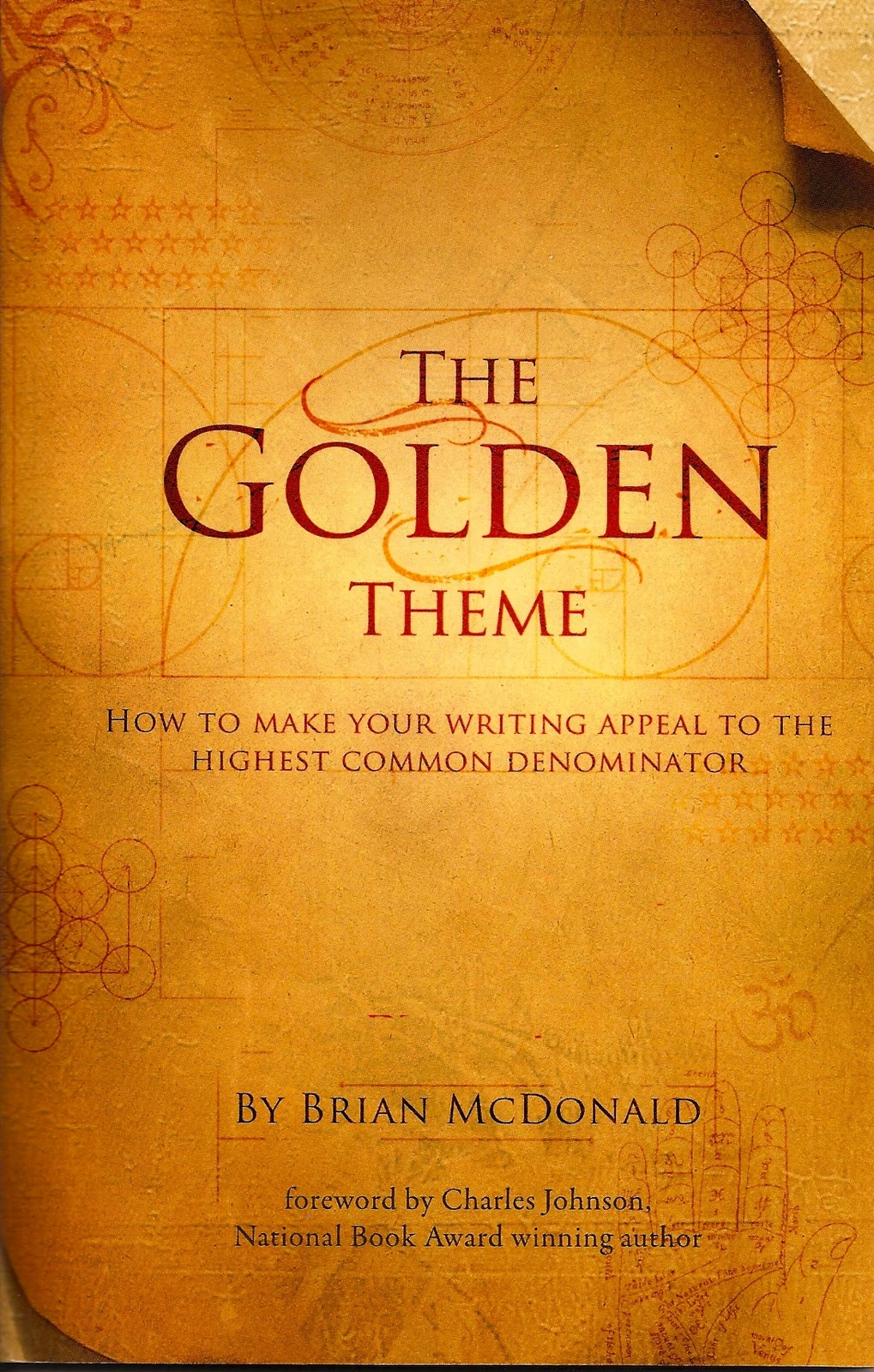
My new book is out(ish)!

I know some of you out there have been waiting for my new book The Golden Theme, well it’s sort of here. What I mean is that it is available for pre-order on Amazon. It will be a week or two before you can hold it your hot little hands, but you can order it right now.


Sorry, Amazon takes a while to put up a cover image for some reason.

Anyway, this is from the foreword by National Book Award winner Charles Johnson:

“Brian McDonald is one of the world’s wisest teachers of
the elements that create great storytelling. On this subject,
you can trust everything he says, because there is simply no
angle or aspect of storytelling – what stories mean and our
experience of them – that he has not deeply reflected upon
(and from the standpoint of numerous disciplines in the
sciences and humanities), then drawn a conclusion that we
can take to the bank….

…If I had not retired last year from teaching classes on literature and
the craft of writing at the University of Washington, I would place
McDonald’s two books before my undergraduate and graduate students as
required reading…

…So my recommendation is quite simple:


If you a writer in any genre, read The Golden Theme. If
you are a non-writing reader who just loves stories, read it. If
you are a teacher, share it with your students. And give it to
friends, who will thank you for the clarity Brian McDonald
so generously brings to our lives.”


-- Charles Johnson


I want to thank everyone for getting the first book, Invisible Ink, and saying such nice things about it. I’m proud of The Golden Theme and hope that you all like it.


Thank you,


-- Brian

Monday, October 04, 2010

A Few Thoughts on Learning


“Being ignorant is not so much a shame, as being unwilling to learn.” -- Benjamin Franklin


Before I start this blog post I will warn you that there is a little bit of swearing and a bit of imagery that may be slightly off-putting to some. But I think the lesson of this post is an important one and worth the risk of offending.

I am often taken aback by students and others I talk to who say they want to learn about something, but then reject information about their subject of interest.


An aspiring screenwriter once approached me. She told me that she was looking for the secret to engaging an audience. She said that there must be a way to hold an audience spellbound and keep their attention. She spoke with the passion of a person on a quest for the secret to the universe. She went on for a while wondering aloud if there was some trick or technique that might help her engage an audience in this way.

I told her that she should read interviews with Alfred Hitchcock, because he was quite articulate about how to involve an audience in your story.

The woman scoffed and said, “I don’t like Hitchcock’s movies, so I don’t care what he said.”

My head still spins when I think about it. Hitchcock had a fifty-year career all because he knew how to play an audience like a fiddle. His nickname is Master of Suspense. The man has a list of classics as long as my arm and this would-be screenwriter blew him off like a one-hit-wonder.


The truth is she didn’t want the answer to her question—she wanted to be on her intellectual quest. For her, pondering this “unanswerable” question was its own reward.

One of the other things is that people will say to me that they’d like to take my class, just to learn screenwriting. They will say, these people, that they already know how to write because they write poetry or something.

They have already made they assumption that they have they aren’t learning a new craft, but merely learning a few technical details particular to screenwriting. This is like a biologist deciding that he can build a rocket ship because he is a scientist after all. How different can it be?

I see this all the time: People dismissing new information with confidence—even cockiness—born of ignorance.

I was once introduced to the friend of a good friend of mine. Both of these people are trained martial artists. This woman, during our chance meeting on the street, mentioned that she was creating her very own martial art. This sounded ridiculous to me, and I wondered just who she thought she was.
When she and my friend were finished with their visits we said our Nice-to-meet-yous and she walked off.

As soon as she was gone, my friend turned to me and said that this woman was the best martial artist he had ever seen—she knew many martial arts and was a champion in them. Whenever she wanted to learn a new form, she never told her teacher who she was; she would take the class as if she was a beginner. She learned the basics and worked her way up to the top.

This is a person who can put her ego aside in order to learn something new. Impressive.

More than once I have finished teaching a class and students have excitedly told me how much they learned. And they say that they want to learn more. If I give them a list of movies to watch, they often point out the films that they have already seen and tell me that they don’t need to see those. Or they will watch some of the films and report back on which ones they didn’t like.

Understand that after the class they tell me how much I changed they way they “see” stories, and yet they blow off the very thing I know will help them learn more: patient study.

First, they shouldn’t refuse to watch a film they have seen because now they are looking with new eyes. They know more than they knew when they saw it before. And secondly, if they don’t like a film on my list, what they should do is ask themselves why I thought they could learn from it.

I had one student who watched, and didn’t like, Billy Wilder’s The Apartment. He had no idea why I thought it was good. But you know what he did? He watched it again. And again. And again. Until he saw what I saw. Now he loves the film and sees the craftsmanship that was invisible to him before. He did the very same thing with Hitchcock’s Rear Window. He now loves that film as well. And he has learned too how to be a better storyteller.

The following story is a little vulgar, but worth telling to make my point, I think.

I used to know a man from a West African village. We once talked about his manhood initiation ritual. He said to me in his thick accent, “In my village when you are a boy in manhood training you must go take a shit (he pronounced it sheet) in the woods.” He paused. “Then you sit all day and you watch your sheet.” Then he paused for a long while. I had no idea what he was getting at. Then he said, “Then you see everything that depends on your sheet.” The boys learn, from this exercise, their vital connection to the rest of the living world. This is a profound lesson to emerge from such seemingly pointless act.

Remember that sometimes when someone is trying to teach you something new, your job is not to judge what he or she asks you to do, but to fully understand why you should do it.

If you do this, you may be surprised by what you have allowed yourself to learn.


Friday, September 24, 2010

You don't know what you don't know


"Everybody is ignorant, only on different subjects
."  ~Will Rogers


In my life I have known many artists who dismiss the idea of structure when it comes to art – and with stories in particular. It doesn’t feel organic for them to work with a plan or to impose a form on their art. They believe that their art will lose emotional power. This is a mistake.

I was once invited to see the one-woman show of an actress I know. She’s a really good actress, smart, funny, quick, talented, and skilled. She gave me tickets to her show and said that following the show there would be a Q&A. I went to the show along with two guests. 

Before the show began the theater was packed and abuzz with anticipation. This actress has quite a local following and people expected to be thoroughly entertained. 

They were not disappointed. The show was funny and engaging and after a spectacular crescendo the lights came up to thunderous applause.

People took this time to grab fresh air and others to smoke in front of the theater.

My friends and I talked about how much we liked the show and debated whether to stay for the Q&A. I thought that I should because she did give me free tickets. So we stayed. But many people did not. I would say more than half of the audience left.

We sat back down expecting the Q&A, but the lights dimmed and, much to our surprise, there was a second part to the show.

When that ended the Q&A did follow. During the Q & A my friend, the actress, commented on the audience that had left at the intermission. She said something to the effect of, “Some people get what I do and some people just don’t get it.” 

This is not an unusual reaction for artist who work strictly from the gut. The “They don’t get me” defense. There are times when that can be true, but mostly it’s the artist who doesn’t “get it,” not the audience.

Thousands of years of conditioning have taught us the natural shape of a story and if you don’t understand that this is so, you may not be clear on just what you are communicating to your audience.

People will often tell me that a film is well structured, but that it is too long. I don’t believe that there is any such thing as too long. Some of the longest films I have ever seen are short films. 

But when a story is aimless and meanders people have no idea of its shape and become uneasy. How many times have you felt like a film was going to end only to have it continue for another 20, 30, or 60 minutes? Each minute past the time when you thought the film was over is a minute too long. It’s poor structure.

If you understand structure you can use people’s expectations to your advantage. I’m not talking about breaking rules so much as bending them.

If you look at James Cameron’s film Aliens, he makes use of audience expectations to create a false ending. There is a fiery climax followed by what appears to be a wrap-up. But we soon find out that this story is not quite done.

Why did this work when my friend’s false climax did not? It’s because the story did not truly resolve. The heroine, Ripley, must do battle with the monster of the story. She must conquer her fear by confronting it in the form of this alien.

At the beginning of the story Ripley is haunted by nightmares of aliens and after this final battle she is free of these dreams. The end.

What my friend failed to realize is that she communicated to us that her show was over. Her show came to a conclusion of an idea culminating with a climax. She told us it was over. But because she did not understand what she had done, she could only blame the viewers.

Understanding the basics of story structure would have helped her keep her audience, and it will help you keep yours.


Friday, September 10, 2010

Happy Birthday, Scott!


This is not my regular kind of post. Today would have been the birthday of my good friend Scott, whom I met 30 years ago. And since this is also the 30th Anniversary year for The Empire Strikes Back I thought I would post this short documentary I made in his honor one more time. If you are tired of seeing it I apologize.


Flickering Images from Marcus Donner on Vimeo.

Happy Birthday, Scott. Wherever you are I hope there are only good Star Wars movies and no 4th Indiana Jones.


Thanks everyone for indulging me.


Tuesday, August 24, 2010

We Have Just Entered The Twilight Zone...


"I happen to think that the singular evil of our time is prejudice. It is from this evil that all other evils grow and multiply."  -- Rod Serling


This is important to me. Up until now I have tried to keep the focus of this blog on film and filmmaking with an emphasis on story construction. And this post will not stray too far from that, but you will get a view of my politics that I have mostly left out of this blog. I may alienate some people, but I am willing to take that chance.

I believe deep in my heart that stories exist to teach us. I go into this in great detail in my second book The Golden Theme, which will be out before the month is out, if all goes smoothly.

I believe that our stories contain the collective wisdom of everyone who has ever lived.

Why do I bring this up? Because I think there is a story that we need to pay attention to right now. Like all good stories, it is timeless and so appears to be timely.

You don’t have to read many of my posts to know what a hero Rod Serling is to me. In 1955 there was a very famous lynching of a black teenager named Emmett Till. This lynching shocked the nation and Rod Serling wanted to write a television play about it.

The sponsors were so worried about the Southern response to the story that they edited Serling's script beyond recognition.

Serling wanted to tell stories that mattered. He decided to make his points in an indirect fashion and created his classic television show The Twilight Zone.

Now, if you are a regular reader of this blog you know all of this. I bring it up because of something that happened this weekend at an anti-Muslim rally in New York. This was a rally about the Islamic community center planned two blocks from Ground Zero, which has been erroneously dubbed “The Ground Zero Mosque.”


At this rally a man was harassed and accused of being a Muslim by an angry, hateful crowd.

This reminded me so much of one of the most insightful Twilight Zone episodes: “The Monsters are Due on Maple Street.”

I suggest that you please watch it and see if you can tell how little we have changed since Mr. Serling wrote this mini-masterpiece fifty years ago. See if you notice how little we have learned to see the humanity in our neighbor – and how quickly we turn to anger, hatred and suspicion.

It’s high time we grew up.


“We have met the enemy and he is us.” – Walt Kelly in his Pogo comic strip


Patterns : the complete scripts of four famous television plays : Patterns, the Rack, Old Macdonald, Requiem for a Heavyweight